Ambiente: milieu / zona climatica / distribuzione batimetrica / gamma di distribuzione
Ecologia
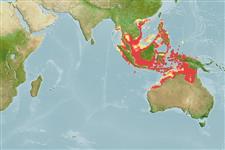
marino associati a barriera corallina; distribuzione batimetrica 10 - 80 m (Ref. 5222). Tropical; 21°N - 21°S, 94°E - 143°E (Ref. 5222)
Western Central Pacific: known only from tropical waters, from Thailand and the Philippines to northern Australia.
Lunghezza alla prima maturità / Dimensione / Peso / Età
Maturità: Lm ?, range 13 - ? cm
Max length : 40.0 cm TL maschio/sesso non determinato; (Ref. 48635)
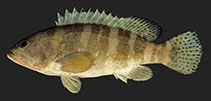
Spine dorsali (totale) : 11; Raggi dorsali molli (totale) : 14 - 16; Spine anali: 3; Raggi anali molli: 8. Preopercle with two to four greatly enlarged serrae at its angle; upper edge of the operculum straight; nostril sub equal. Maxilla reaches to or slightly past the vertical a rear edge of the eye. Pectoral fins not fleshy. Pyloric caeca 7 or 8. Color of head and body pale grayish brown with 5 dark brown bars on the body and 1 on nape. Scattered pale spots may be present on body and some faint small brown spots are often on the edges of the dark bars. The soft dorsal, caudal, and pelvic fins dusky gray, the pectoral fins grayish or orange-red. The jaws and ventral parts of the head sometimes pale reddish brown.
Body shape (shape guide): fusiform / normal; Cross section: compressed.
Common on silty sand or mud bottoms. Its preference for soft-bottom habitats may account for its restricted distribution and absence at oceanic islands. Feeds on small fishes and crustaceans (Ref. 89707).
Ciclo vitale e comportamento di accoppiamento
Maturità | Riproduzione | Deposizione | Uova | Fecondità | Larve
Heemstra, P.C. and J.E. Randall, 1993. FAO Species Catalogue. Vol. 16. Groupers of the world (family Serranidae, subfamily Epinephelinae). An annotated and illustrated catalogue of the grouper, rockcod, hind, coral grouper and lyretail species known to date. Rome: FAO. FAO Fish. Synop. 125(16):382 p. (Ref. 5222)
Stato della Lista Rossa IUCN (Ref. 130435: Version 2025-2 (Global))
Minaccia per l'uomo
Harmless
Usi umani
Pesca: commerciale
Strumenti
Rapporti speciali
Scarica XML
Fonti Internet
Stime basate su modelli
Temperatura preferita (Fonte Biblio.
123201): 26.8 - 29.1, mean 28.3 °C (based on 926 cells).
Indice di diversità filogenetica (Fonte Biblio.
82804): PD
50 = 0.5000 [Uniqueness, from 0.5 = low to 2.0 = high].
Bayesian length-weight: a=0.01288 (0.00802 - 0.02069), b=3.05 (2.92 - 3.18), in cm total length, based on LWR estimates for this species & Genus-body shape (Ref.
93245).
Livello trofico (Fonte Biblio.
69278): 3.8 ±0.4 se; based on diet studies.
Generation time: 2.2 ( na - na) years. Estimated as median ln(3)/K based on 1
growth studies.
Resilienza (Fonte Biblio.
120179): Medio, tempo minimo di raddoppiamento della popolazione 1.4 - 4.4 anni (K=0.16).
Vulnerabilità della pesca (Ref.
59153): Low to moderate vulnerability (26 of 100).
🛈
Nutrienti (Ref.
124155): Calcium = 37.5 [18.4, 75.6] mg/100g; Iron = 0.574 [0.309, 1.201] mg/100g; Protein = 18.6 [17.1, 19.9] %; Omega3 = 0.136 [0.085, 0.214] g/100g; Selenium = 38.1 [21.1, 66.9] μg/100g; VitaminA = 158 [44, 554] μg/100g; Zinc = 1.34 [0.92, 1.89] mg/100g (wet weight); based on
nutrient studies.