>
Siluriformes (Catfishes) >
Loricariidae (Armored catfishes) > Hypostominae
Etymology: Peckoltia: Because of Gustavo Peckolt,member of the Natural History Commission of Rondon (Ref. 45335).
Eponymy: Gustavo Peckolt (1861–1923) was a Brazilian-born German botanist and pharmacist. [...] Professor Dr August Bernhard Brauer (1863–1917) was a German herpetologist and ichthyologist. [...] (Ref. 128868), visit book page.
More on author: Eigenmann.
Taxonomic Remarks
No recent work; short redescription including the future type specimens in a footnote by Kner (1854:281).
Meio ambiente: milieu / Zona climática / intervalo de profundidade / faixa de distribuição
Ecologia
; Água doce demersal. Tropical
South America: Guyana and Brazil.
Tamanho / Peso / Idade
Maturidade: Lm ? range ? - ? cm
Max length : 10.3 cm SL macho/indeterminado; (Ref. 54521)
Descrição suscinta
Chaves de identificação | Morfologia | Morfometria
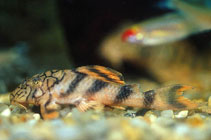
Espinhos dorsais (total) : 2; Raios dorsais (total) : 7; Espinhos anais: 1; Raios anais : 4. Distinguished from all other species of Peckoltia except P. cavaticaby having an orange band in the dorsal fin and by having thin, wavy, black lines that tend to outline the plates and bones of the head. Differs from P. cavatica by having the dorsal saddles better developed, by having the head plates and bones completely outlined in black and with lines intense, by having black vermiculations on the pterotic-supracleithrum, by having at least one, broken band in the caudal fin, and by having the marginal orange band of the dorsal and caudal fins not as thick or as intense as in P. cavatica (Ref. 54521).
Body shape (shape guide): elongated.
Facultative air-breathing in the genus (Ref. 126274); Inhabits swift riffles among very large boulders (Ref. 54521).
Ciclo de vida ou comportamento de acasalamento
Maturidade | Reprodução | Desova | Ovos | Fecundidade | Larvas
Fisch-Muller, S., 2003. Loricariidae-Ancistrinae (Armored catfishes). p. 373-400. In R.E. Reis, S.O. Kullander and C.J. Ferraris, Jr. (eds.) Checklist of the Freshwater Fishes of South and Central America. Porto Alegre: EDIPUCRS, Brasil. (Ref. 36713)
Status na Lista Vermelha da UICN (Ref. 130435: Version 2025-2 (Global))
Ameaça para os humanos
Harmless
Uso pelos humanos
Ferramentas
Relatórios especiais
Baixar XML
Fontes da internet
Estimativas baseadas em modelos
Índice de diversidade filogenética (Ref.
82804): PD
50 = 0.5000 [Uniqueness, from 0.5 = low to 2.0 = high].
Bayesian length-weight: a=0.01549 (0.00726 - 0.03306), b=2.96 (2.79 - 3.13), in cm total length, based on LWR estimates for this (Sub)family-body shape (Ref.
93245).
Resiliência (Ref.
120179): Elevada, tempo mínimo de duplicação da população menor que 15 meses (Preliminary K or Fecundity.).
Vulnerabilidade da pesca (Ref.
59153): Low vulnerability (10 of 100).
🛈