Taxonomic Remarks
FishBase common name changed from Yellowstriped goatfish to Striped goatfish (Uiblein et al., 2024: Ref. 130857).
Meio ambiente: milieu / Zona climática / intervalo de profundidade / faixa de distribuição
Ecologia
marinhas; estuarina associadas(os) a recifes; intervalo de profundidade 5 - 100 m (Ref. 48636). Tropical; 26°C - 29°C; 32°N - 33°S, 28°E - 137°W
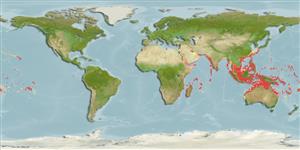
Indo-Pacific: Persian Gulf (Ref.80050); Red Sea south to East London, South Africa and east to Micronesia and the Hawaiian, Marquesan, and Society islands, north to southern Japan, south to New Caledonia.
Comprimento de primeira maturação / Tamanho / Peso / Idade
Maturidade: Lm 12.8, range 10 - ? cm
Max length : 28.0 cm TL macho/indeterminado; (Ref. 30573); common length : 20.0 cm TL macho/indeterminado; (Ref. 5450)
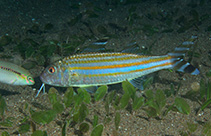
Espinhos dorsais (total) : 8; Raios dorsais (total) : 9; Espinhos anais: 1; Raios anais : 7. This species is distinguished by the following characters: D VIII,9; pectoral fins 15-16; gill rakers 7-8 + 19-21 = 27-29; lateral line scales 36-38; body depth at first dorsal fin origin 25-29% SL and at anal-fin origin 21-24% SL; caudal-peduncle depth 9.9-12% SL; maximum head depth 21-26% SL; head depth through eye 18-20% SL; head length 30-31%SL; orbit length 7.0-8.7% SL; upper jaw length 11-13% SL; barbel length 17-21% SL; caudal-fin length 26-30% SL; anal-fin height 15-16% SL; pelvic-fin length 18-21% SL; pectoral-fin length 22-24% SL; first dorsal-fin height 22-25% SL; second dorsal-fin height 14-16% SL; 7-9 total bars on caudal fin, 4-5 brown or dark brown bars on upper caudal-fin lobe, 3 (rarely 4) bars on lower lobe, increasing distally in width with the widest distal-most bar black or dark brown, while the other bars are pale brown or brown; width of largest lower caudal-fin lobe bar and/or pale interspace between distal-most bars equal to or larger than orbit; tip of lower fin lobe pale (bars on both caudal-fin lobes retained on preserved fish); tip of first dorsal-fin dark, the vertical length of the pigmented area similar in size to width of widest lower caudal-fin lobe bar; 2 yellow or pale brown mid-lateral body stripes, one from eye to caudal-fin base, where it joins the proximal upper caudal-fin lobe bar, and the other stripe below from pectoral-fin base to caudal peduncle and continued by proximal-most lower caudal fin lobe bar; 2 dorsolateral brown or pale brown stripes, with the lower one distinct and well-separated from pale body surface, extending from operculum to behind second dorsal fin, the upper one indistinct or hidden and much shorter, beginning below first dorsal-fin origin and bordered dorsally by a horizontal series of pale spots (lateral body stripes not retained on preserved fish); barbels white; white to silvery body. Dark reddish-brown dorsally, white belly, faint yellowish patches along pelvic and anal-fin bases (body pale brown in preserved fish, slightly darker above lateral line) (Ref. 83903).
Body shape (shape guide): fusiform / normal; Cross section: oval.
Euryhaline (Ref. 12743). Inhabits sandy lagoons and sheltered coastal waters. Also found over muddy bottoms (Ref. 5213). Benthopelagic (Ref. 58302). Often in groups (Ref. 9710). In the north-east coast of India, the male to female ratio was 1:1.5 in most months (Ref. 28761). Feeds primarily on small crustaceans. Marketed fresh (Ref. 5284).
Ciclo de vida ou comportamento de acasalamento
Maturidade | Reprodução | Desova | Ovos | Fecundidade | Larvas
Myers, R.F., 1991. Micronesian reef fishes. Second Ed. Coral Graphics, Barrigada, Guam. 298 p. (Ref. 1602)
Status na Lista Vermelha da UICN (Ref. 130435: Version 2025-2 (Global))
Ameaça para os humanos
Harmless
Uso pelos humanos
Pescarias: espécies comerciais; Aquário: Espécies comerciais
Ferramentas
Relatórios especiais
Baixar XML
Fontes da internet
Estimativas baseadas em modelos
Temperatura preferida (Ref.
123201): 24.6 - 29.1, mean 28.1 °C (based on 1854 cells).
Índice de diversidade filogenética (Ref.
82804): PD
50 = 0.5000 [Uniqueness, from 0.5 = low to 2.0 = high].
Bayesian length-weight: a=0.00933 (0.00787 - 0.01107), b=3.10 (3.07 - 3.13), in cm total length, based on LWR estimates for this species (Ref.
93245).
Nível Trófico (Ref.
69278): 3.6 ±0.0 se; based on diet studies.
Resiliência (Ref.
120179): médio(a), tempo mínimo de duplicação da população 1,4 - 4,4 anos (K=0.3-1.03; tm=1).
Prior r = 1.19, 95% CL = 0.79 - 1.79, Based on 4 data-limited stock assessments.
Vulnerabilidade da pesca (Ref.
59153): Low vulnerability (24 of 100).
🛈
Nutrientes (Ref.
124155): Calcium = 57.2 [30.7, 101.6] mg/100g; Iron = 0.56 [0.26, 0.93] mg/100g; Protein = 18.3 [16.1, 20.7] %; Omega3 = 0.192 [0.122, 0.354] g/100g; Selenium = 32.7 [18.1, 64.4] μg/100g; VitaminA = 90 [27, 322] μg/100g; Zinc = 1.36 [0.84, 1.89] mg/100g (wet weight);