>
Gadiformes (Cods) >
Gadidae (Cods and haddocks)
Etymology: Trisopterus: Greek, tris = thrice + Greek, pteron = wing, fin (Ref. 45335).
More on author: Linnaeus.
Taxonomic Remarks
The species has been long thought to be present in the Mediteranean in sympatry with Trisopterus capelanus, sometimes both as subspecies. See Delling et al. (2011: Ref. 90172) for the latest revision of the genus.
Entorno: milieu / zona climática / rango de profundidad / gama de distribución
Ecología
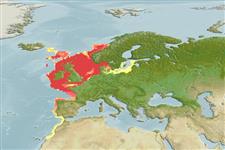
marino bentopelágico; no migratorio; rango de profundidad 1 - 440 m (Ref. 57178), usually 15 - 200 m. Temperate; 66°N - 28°N, 13°W - 36°E
Northeastern Atlantic: Trondheim Fjord and the Faeroe Islands to Portugal and along the Atlantic coast of Morocco (Ref. 1371). Not present in the Mediterranean (Ref. 90172).
Longitud en la primera madurez / Tamaño / Peso / Edad
Madurez: Lm 13.3, range 10 - 26 cm
Max length : 40.0 cm TL macho / no sexado; (Ref. 1371); common length : 20.0 cm TL macho / no sexado; (Ref. 4645); edad máxima reportada: 5 años (Ref. 72488)
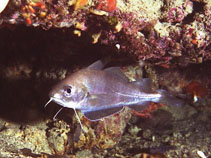
Espinas dorsales (total) : 0; Espinas anales: 0. Chin barbel well developed. Body brownish yellow dorsally, becoming paler ventrally; a dark blotch is at the base of the pectoral fin.
Body shape (shape guide): fusiform / normal; Cross section: circular.
Occurs mostly from 15 to 200 m in the Atlantic on muddy or sandy bottoms. Feeds on crustaceans, small fish, and polychaetes (Ref. 1371). Used in the production of fish meal, and in southern Europe as a human food (Ref. 35388).
Oviparous, sexes are separate (Ref. 205).
Cohen, D.M., T. Inada, T. Iwamoto and N. Scialabba, 1990. FAO species catalogue. Vol. 10. Gadiform fishes of the world (Order Gadiformes). An annotated and illustrated catalogue of cods, hakes, grenadiers and other gadiform fishes known to date. FAO Fish. Synop. 125(10). Rome: FAO. 442 p. (Ref. 1371)
Situación en la Lista Roja de la UICN (Ref. 130435: Version 2025-2 (Global))
Amenaza para el ser humano
Harmless
Usos humanos
Pesquerías: comercial
Herramientas
Informes especiales
Descargar XML
Fuentes de Internet
Estimaciones basadas en modelos
Temperatura preferida (Referencia
123201): 7.2 - 13, mean 10 °C (based on 1312 cells).
Índice de diversidad filogenética (Referencia
82804): PD
50 = 0.5625 [Uniqueness, from 0.5 = low to 2.0 = high].
Bayesian length-weight: a=0.00741 (0.00664 - 0.00828), b=3.11 (3.08 - 3.14), in cm total length, based on LWR estimates for this species (Ref.
93245).
Nivel trófico (Referencia
69278): 3.7 ±0.2 se; based on diet studies.
Generation time: 2.7 (2.2 - 4.2) years. Estimated as median ln(3)/K based on 10
growth studies.
Resiliencia (Referencia
120179): Medio, población duplicada en un tiempo mínimo de 1.4-4.4 años (K=0.18; tm=1; tmax=6).
Prior r = 0.54, 95% CL = 0.35 - 0.81, Based on 2 full stock assessments.
Vulnerabilidad pesquera (Ref.
59153): Moderate vulnerability (37 of 100).
🛈
Vulnerabilidad climática (Ref.
125649): Low vulnerability (7 of 100).
🛈
Nutrientes (Ref.
124155): Calcium = 66.1 [16.9, 219.6] mg/100g; Iron = 0.674 [0.145, 2.965] mg/100g; Protein = 18.3 [15.8, 20.4] %; Omega3 = 0.701 [0.351, 1.389] g/100g; Selenium = 19.3 [9.3, 38.8] μg/100g; VitaminA = 16.6 [3.8, 72.1] μg/100g; Zinc = 1.13 [0.27, 3.13] mg/100g (wet weight); based on
nutrient studies.