Umwelt: Milieu / Klimazone / Tiefenbereich / Verbreitungsgebiet
Ökologie
seewasser; süßwasser; brackwasser demersal; tiefenbereich 1 - 140 m (Ref. 9895). Tropical
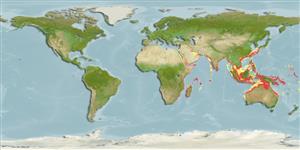
Indo-West Pacific: India eastward to the Malay Archipelago and the South China Sea, southward to the Philippines and northwest Australia; eastward to New Guinea (Ref. 9895). A related species, Cynoglossus gilchristi Regan, 1920 is recorded from Madagascar, the holotype (BMNH n°1903.9.29:2) being from Natal, off Umlanga River (Ref. 6806).
Größe / Gewicht / Alter
Geschlechtsreife: Lm ? range ? - ? cm
Max length : 35.0 cm SL Männchen/unbestimmt; (Ref. 48637); common length : 9.0 cm TL Männchen/unbestimmt; (Ref. 9895)
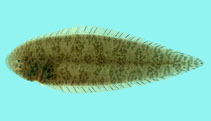
Rückenflossenstacheln (insgesamt) : 0; Rückenflossenweichstrahlen (insgesamt) : 90 - 100; Afterflossenstacheln: 0; Afterflossenweichstrahlen: 72 - 78; Wirbelzahl: 44 - 49. Ocular side yellow-brown. Dorsal and anal fins joined to caudal. Eyes both on the left side of the body, a narrow space separating them; asymmetrical mouth; rostral hook below mouth. Ocular side with 2 lateral lines. Only the left ventral fin present (Ref 28). With very irregular dark brown blotches, often forming irregular cross bands. Some rays of dorsal and anal fins dashed with dark brown. Scales ctenoid on both sides of body. Midlateral-line scales 78 to 99. Scale rows between lateral lines on eyed side 15 to 19 (Ref 9895).
Body shape (shape guide): elongated; Cross section: flattened.
Found on the continental shelf over sandy and muddy bottoms. Occurs in the lower courses of flowing rivers and in estuaries (Ref. 12693, 48637). Feeds mostly on benthic invertebrates. Sold fresh, frozen, or dried salted in markets (Ref. 6806).
Lebenszyklus und Paarungsverhalten
Geschlechtsreife | Fortpflanzung | Ablaichen | Eier | Fruchtbarkeit | Larven
Munroe, T.A., 2001. Cynoglossidae. Tonguesoles. p. 3890-3901. In K.E. Carpenter and V. Niem (eds.) FAO species identification guide for fishery purposes. The living marine resources of the Western Central Pacific. Vol. 6. Bony fishes part 4 (Labridae to Latimeriidae), estuarine crocodiles. FAO, Rome. (Ref. 9895)
IUCN Rote Liste Status (Ref. 130435: Version 2025-2 (Global))
Bedrohung für Menschen
Harmless
Nutzung durch Menschen
Fischereien: kommerziell
Tools
Zusatzinformationen
Download XML
Internet Quellen
Schätzungen auf der Grundlage von Modellen
Bevorzugte Temperatur (Ref.
123201): 24.3 - 29.1, mean 28 °C (based on 2476 cells).
Phylogenetischer Diversitätsindex (Ref.
82804): PD
50 = 0.5000 [Uniqueness, from 0.5 = low to 2.0 = high].
Bayesian length-weight: a=0.00468 (0.00289 - 0.00758), b=3.13 (2.99 - 3.27), in cm total length, based on LWR estimates for this species & Genus-body shape (Ref.
93245).
Trophische Ebene (Ref.
69278): 3.5 ±0.41 se; based on food items.
Generation time: 1.7 ( na - na) years. Estimated as median ln(3)/K based on 1
growth studies.
Widerstandsfähigkeit (Ref.
120179): hoch, Verdopplung der Population dauert weniger als 15 Monate. (K=0.65).
Anfälligkeit der Fischerei (Ref.
59153): Low vulnerability (24 of 100).
🛈