>
Siluriformes (Catfishes) >
Auchenipteridae (Driftwood catfishes) > Auchenipterinae
Etymology: Ageneiosus: Greek, a = without + greek, geneias, -ados = bear, chin (Ref. 45335).
More on author: Linnaeus.
Taxonomic Remarks
Redescribed in Walsh (pers comm., and 1990) as Ageneiosus brevifilis Valenciennes.
Lingkungan: lingkungan / zona iklim / kisaran kedalaman / jangkauan distribusi
Ekologi
; air tawar pelagis, permukaan; pH range: 6.5 - 7.8; dH range: ? - 20. Tropical; 22°C - 24°C (Ref. 2060)
South America: Argentina, Bolivia, Brazil, Colombia, Ecuador, French Guiana, Guyana, Paraguay, Suriname, and Venezuela (Ref. 37098). Reported from Uruguay (Ref. 54736).
Ukuran / Berat / umur
Kematangan: Lm ? range ? - ? cm
Max length : 64.8 cm TL jantan/; (Ref. 111518); Berat maksimum terpublikasi: 3.1 kg (Ref. 111518)
deskripsi pendek
Kunci identifiaksi (pengenalan) | Morfologi | Morfometrik
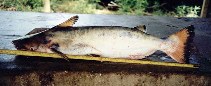
Sirip dubur lunak: 34 - 40; vertebrata, bertulang belakang: 46 - 51. Body naked and elongated. Head is pointed and depressed at the top. Mouth is big and wide. The lateral eyes are situated along the level of the mouth, ensuring a vision above and below. Exhibits sexual dimorphism, like A. dentatus. The first ray of the dorsal fin is very long and has pointed spines (Ref. 35381).
Body shape (shape guide): elongated.
Prefers rivers in overgrown backwaters where the current is not too strong. Reported to be nocturnal. Feeds on fish and crustaceans. The flesh is esteemed for its very fine flavor. Frequently captured with nets, with males difficult to release from the nets because of its strong dorsal spine that is bordered with denticles (Ref. 27188). During reproduction, the mandibular barbels and dorsal spine of the male change, and a copulatory organ appears at the anterior level of the anal fin. Fertilization is internal, the female being capable of keeping the spermatozoids inserted in the epithelium of her genital tract (Ref. 35381).
Siklus hidup dan perilaku kawin
Kematangan | Reproduksi, perkembang biakan | Pemijahan | telur-telur | Fekunditas | Larva
Female lays eggs on plants a few days after fertilization (Ref. 2060). The females can preserve keep fertile spermatozoids by coating these with secretions of maternal origin and inserting these in the epithelium of its genital tract (Ref. 27188).
Ferraris, C.J. Jr., 2003. Auchenipteridae (Driftwood catfishes). p. 470-482. In R.E. Reis, S.O. Kullander and C.J. Ferraris, Jr. (eds.) Checklist of the Freshwater Fishes of South and Central America. Porto Alegre: EDIPUCRS, Brasil. (Ref. 37098)
Status IUCN Red List (Ref. 130435: Version 2025-2 (Global))
ancaman kepada manusia
Harmless
penggunaan manusia
Perikanan: komersial; Ikan buruan: ya; Akuarium: Akuarium publik
Alat, peralatan
laporan khas
muat turun XML
Sumber internet
Estimasi berdasarkan model
Indeks keanekaragaman filogenetik (Acuan
82804): PD
50 = 0.5001 [Uniqueness, from 0.5 = low to 2.0 = high].
Bayesian length-weight: a=0.00955 (0.00745 - 0.01224), b=3.04 (2.99 - 3.09), in cm total length, based on LWR estimates for this species (Ref.
93245).
Tingkat Trofik (Acuan
69278): 4.0 ±0.66 se; based on food items.
Daya lenting (Acuan
120179): sedang, Waktu penggandaan populasi minimum 1.4 - 4.4 tahun (Assuming tm=2-4, Fec>1000).
Kerentanan Penangkapan Ikan (Ref.
59153): Moderate to high vulnerability (46 of 100).
🛈
Nutrisi (Ref.
124155): Calcium = 109 [55, 259] mg/100g; Iron = 1.47 [0.80, 2.90] mg/100g; Protein = 17.7 [15.4, 19.8] %; Omega3 = 0.247 [0.100, 0.606] g/100g; Selenium = 36.8 [13.5, 100.3] μg/100g; VitaminA = 31.7 [10.5, 99.2] μg/100g; Zinc = 1.42 [0.91, 2.14] mg/100g (wet weight); based on
nutrient studies.