>
Gymnotiformes (Knifefishes) >
Sternopygidae (Glass knifefishes) > Eigenmanninae
Etymology: Archolaemus: Greek, archo = anus + Greek, laimos = throat (Ref. 45335).
Entorno: milieu / zona climática / rango de profundidad / gama de distribución
Ecología
; agua dulce bentopelágico. Tropical
South America: Previously known only from the Tocantins drainage in Brazil, but has recently been reported in many localities of the Amazonas basin, Rio Branco and Amapa, Brazil.
Tamaño / Peso / Edad
Madurez: Lm ? range ? - ? cm
Max length : 43.5 cm TL macho / no sexado; (Ref. 39524)
Descripción breve
Claves de identificación | Morfología | Morfometría
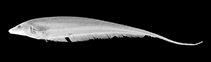
Radios blandos anales: 193 - 222. Distinguished from other congeners in having the following combination of characters: gape relatively long and rictus extending posteriorly beyond the vertical through the posterior naris; length of coronomeckelian bone less than 20% the length of Meckel’s cartilage; length of the posterior ceratohyal 1.5 times the length of the ventral hypohyal; approximately six irregularly distributed teeth on the internal surface of the endopterygoid; anteroposterior length of premaxilla greater than the transverse width; teeth on the dentary restricted to the anterior half or slightly more of the dorsal margin; depth of the caudal filament 5.0-6.5% CL; presence of a narrow dark stripe along the lateral line and a broad dusky to dark band of pigmentation overlying the basal pterygiophores of the anal fin; pectoral-fin rays 19-22; total number of anal-fin rays 193-222 (Ref. 93148).
Body shape (shape guide): elongated.
Its elongated, laterally compressed body is completely covered with scales and is without a caudal fin (Ref. 27188).
Ciclo vital y comportamiento de apareamiento
Madurez | Reproducción | Puesta | Huevos | Fecundidad | Larva
Mago-Leccia, F., 1994. Electric fishes of the continental waters of America. Fundacion para el Desarrollo de las Ciencias Fisicas, Matematicas y Naturales (FUDECI), Biblioteca de la Academia de Ciencias Fisicas. Matematicas y Naturales, Caracas, Venezuela. vol. 29 . 206 p. (Ref. 26457)
Situación en la Lista Roja de la UICN (Ref. 130435: Version 2025-2 (Global))
Amenaza para el ser humano
Harmless
Usos humanos
Herramientas
Informes especiales
Descargar XML
Fuentes de Internet
Estimaciones basadas en modelos
Índice de diversidad filogenética (Referencia
82804): PD
50 = 0.5156 [Uniqueness, from 0.5 = low to 2.0 = high].
Bayesian length-weight: a=0.00355 (0.00161 - 0.00782), b=2.97 (2.78 - 3.16), in cm total length, based on LWR estimates for this (Sub)family-body shape (Ref.
93245).
Nivel trófico (Referencia
69278): 3.1 ±0.3 se; based on size and trophs of closest relatives
Vulnerabilidad pesquera (Ref.
59153): Low to moderate vulnerability (34 of 100).
🛈