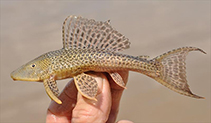
>
Siluriformes (Catfishes) >
Loricariidae (Armored catfishes) > Hypostominae
Etymology: Pterygoplichthys: Greek, pterygion, diminutive of pteryx = wing, fin + Greek, hoplon = weapon + Greek, ichthys = fish (Ref. 45335).
Taxonomic Remarks
New combination in Günther (1864:238). Redescription in Weber (1992:9). Mitochondrial D-loop sequences used in a molecular phylogeny of Hypostomus and related genera by Montoya-Burgos and Weber (in press, fig 2; EMBL/GenBank AJ318361).
Environnement : milieu / zone climatique / profondeur / gamme de distribution
Écologie
; eau douce démersal; pH range: 6.5 - 7.8; dH range: 4 - 20. Tropical; 23°C - 27°C (Ref. 1672); 10°N - 1°N, 68°W - 61°W
South America: Orinoco River basin. Reported from Argentina (Ref. 9086). Introduced and have established in Taiwan, mainland USA and Hawaii (Refs. 5723, 44091, 58503).
Longueur à la première maturité / Taille / Poids / Âge
Maturité: Lm 32.5, range 25 - 40 cm
Max length : 50.0 cm TL mâle / non sexé; (Ref. 2059)
Description synthétique
Clés d'identification | Morphologie | Morphométrie
Facultative air-breathing (Ref. 126274); Occurs in streams and lakes (Ref. 44091) and in weedy, mud-bottomed canals (Ref. 5723). Benthic (Ref. 58302). Nocturnal, feeds on algae (Ref. 13371), but will also feed on worms, insect larvae, and other bottom-dwelling aquatic animals (Ref. 44091). Spawning period peaks once a year (Ref. 56986). Reproductive behavior includes digging of burrows for egg laying (Ref. 82067). May exhibit male parental care (Ref. 56986).
Cycle de vie et comportement reproducteur
Maturité | Reproduction | Frai | Œufs | Fécondité | Larves
Parental care may be exhibited by males (Ref. 56986).
Burgess, W.E., 1989. An atlas of freshwater and marine catfishes. A preliminary survey of the Siluriformes. T.F.H. Publications, Inc., Neptune City, New Jersey (USA). 784 p. (Ref. 6868)
Statut dans la liste rouge de l'IUCN (Ref. 130435: Version 2025-2 (Global))
Menace pour l'homme
Harmless
Utilisations par l'homme
Pêcheries: sans intérêt; Aquarium: Commercial
Outils
Articles particuliers
Télécharger en XML
Sources Internet
Estimations basées sur des modèles
Indice de diversité phylogénétique (Réf.
82804): PD
50 = 0.5000 [Uniqueness, from 0.5 = low to 2.0 = high].
Bayesian length-weight: a=0.02291 (0.01240 - 0.04232), b=2.91 (2.76 - 3.06), in cm total length, based on LWR estimates for this species & Genus-body shape (Ref.
93245).
Niveau trophique (Réf.
69278): 2.2 ±0.12 se; based on food items.
Résilience (Réf.
120179): Milieu, temps minimum de doublement de population : 1,4 à 4,4 années (tm=1; Fec = 1,983).
Vulnérabilité de la pêche (Ref.
59153): Moderate vulnerability (40 of 100).
🛈