Klassifizierung / Names
Namen | Synonyme | Catalog of Fishes(Gattung, Arten) | ITIS | CoL | WoRMS | Cloffa
>
Gymnotiformes (Knifefishes) >
Apteronotidae (Ghost knifefishes) > Apteronotinae
Etymology: Megadontognathus: Greek, megas, megalos = great + Greek, odous = teeth + Greek, gnathos = jaw (Ref. 45335).
Umwelt: Milieu / Klimazone / Tiefenbereich / Verbreitungsgebiet
Ökologie
; süßwasser benthopelagisch. Tropical
South America: Known only from the Cuyuni Basin and the Rio Caroní in Venezuela.
Größe / Gewicht / Alter
Geschlechtsreife: Lm ? range ? - ? cm
Max length : 23.8 cm TL Männchen/unbestimmt; (Ref. 26457)
Kurzbeschreibung
Bestimmungsschlüssel | Morphologie | Morphometrie
Rückenflossenstacheln (insgesamt) : 0; Rückenflossenweichstrahlen (insgesamt) : 0; Afterflossenweichstrahlen: 159 - 169; Wirbelzahl: 90. Considered unique among apteronotids by its dentition: 2-3 large conical teeth on the posterior end of dentary; 2-3 minute, conical teeth on each premaxillary.
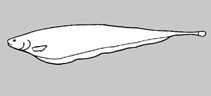
Body shape (shape guide): elongated.
Lebenszyklus und Paarungsverhalten
Geschlechtsreife | Fortpflanzung | Ablaichen | Eier | Fruchtbarkeit | Larven
Mago-Leccia, F., 1994. Electric fishes of the continental waters of America. Fundacion para el Desarrollo de las Ciencias Fisicas, Matematicas y Naturales (FUDECI), Biblioteca de la Academia de Ciencias Fisicas. Matematicas y Naturales, Caracas, Venezuela. vol. 29 . 206 p. (Ref. 26457)
IUCN Rote Liste Status (Ref. 130435: Version 2025-2 (Global))
Bedrohung für Menschen
Harmless
Nutzung durch Menschen
Tools
Zusatzinformationen
Download XML
Internet Quellen
Schätzungen auf der Grundlage von Modellen
Phylogenetischer Diversitätsindex (Ref.
82804): PD
50 = 0.7500 [Uniqueness, from 0.5 = low to 2.0 = high].
Bayesian length-weight: a=0.00355 (0.00146 - 0.00863), b=3.06 (2.85 - 3.27), in cm total length, based on LWR estimates for this (Sub)family-body shape (Ref.
93245).
Trophische Ebene (Ref.
69278): 3.3 ±0.3 se; based on size and trophs of closest relatives
Anfälligkeit der Fischerei (Ref.
59153): Low vulnerability (14 of 100).
🛈