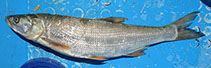
Milieu: milieu / Klimaatzone / Diepte / verspreidingsgebied
Ecologie
; zoet water; brak water benthopelagisch; potamodroom (Ref. 51243); diepte 10 - ? m (Ref. 30578). Temperate; 4°C - 20°C (Ref. 2059); 66°N - 35°N, 3°E - 72°E
Europe and Asia: large rivers draining to North Sea (Weser, Elbe), Baltic Sea (southern tributaries, Norway east of Oslo, southern Sweden, Kokemären drainage in southern Finland), Black Sea, Sea of Azov and Caspian Sea; Aegean Sea basin, from Maritza to Lake Volvi drainages. Absent in Black Sea basin south of Danube and Rioni (Georgia) drainages, but present in Turkey west of Ankara. Introduced in Rhine, Northern Dvina and Lake Balkhash (Asia) (Ref. 59043). The subspecies Aspius aspius iblioides was previously recognized by authors for the Aral Sea (Ref. 13403).
Lengte bij maturiteit / Grootte / Gewicht / Leeftijd
Maturiteit: Lm ? range ? - ? cm
Max length : 120 cm TL mannelijk / geslacht onbekend; (Ref. 35387); common length : 55.0 cm TL mannelijk / geslacht onbekend; (Ref. 30578); max. gepubliceerd gewicht: 9.0 kg (Ref. 556); max. gerapporteerde leeftijd: 11 Jaren (Ref. 40480)
Korte beschrijving
Determinatiesleutels | Morfologie | Morfometrie
Dorsale stekels (totaal) : 3; Dorsale zachte stralen (totaal) : 7 - 9; Anale stekels: 3; Anale zachte stralen: 12 - 15. The only species of Aspius in Europe which can be diagnosed from other species of Cyprinidae in Europe by the following characters: anal fin with 12-14½ branched rays; scales on lateral line 64-76; maxilla extending beyond front margin of eye; and sharp keel between pelvic-fin and anal-fin origins covered by scales (Ref. 59043). Long shape body, laterally compressed with a long sharp head. Green back with silver to blue tints. Lighter flanks. Silver white belly. Pectoral, pelvic and anal fins grey to brown. Scale formula: 11-14/64-76/5-6 (Ref. 40476).
Body shape (shape guide): fusiform / normal.
Occur in open water of large and medium-sized lowland rivers and large lakes (Ref. 59043). Adults inhabit lower reaches of rivers and estuaries (Ref. 30578). Prefer to stay near bridge pillars, near tributaries, under weirs, in deep currents and overgrown parts of river and in quiet bays of river bends (Ref. 9696). One of the rare cyprinids which is piscivore; also prey on small aquatic birds. Juveniles are gregarious predators while adults hunt in small groups or are solitary. Juveniles and adults feed mainly on fish, especially on Alburnus alburnus or Osmerus eperlanus (Ref. 59043). Migrate upstream in tributaries for spawning in April-June (Ref. 556, 30578). Spawn in fast-flowing water on gravel or submerged vegetation. Lake populations migrate to tributaries; semi-anadromous populations or individuals (Terek) forage mainly in estuaries and freshened parts of the sea, migrating to rivers only for spawning. Begins spawning migration in second half of October (Terek) and overwinters in the lower reaches of river. Hybridizes with Leuciscus idus. Threatened due to alteration of river morphology (Ref. 59043).
Sexual maturity is reached after 4-5 years (Ref. 2059). Reproductive success seems to be associated with low water level and high spring temperatures. Spawning occurs more than one season and lasts about 2 weeks. Deposits eggs which adhere to gravel or submerged plants (Ref. 59034).
Vostradovsky, J., 1973. Freshwater fishes. The Hamlyn Publishing Group Limited, London. 252 p. (Ref. 9696)
Status op de Rode Lijst van het IUCN (Ref. 130435: Version 2025-2 (Global))
Gevaar voor de mens
Harmless
Gebruik door de mens
Visserij: commercieel; Aquacultuur: commercieel; sportvis: ja
Tools
Speciale rapporten
Download XML
Internetbronnen
Schattingen op basis van modellen
Fylogenetische diversiteitsindex (Ref.
82804): PD
50 = 0.5000 [Uniqueness, from 0.5 = low to 2.0 = high].
Bayesian length-weight: a=0.00468 (0.00404 - 0.00542), b=3.14 (3.11 - 3.17), in cm total length, based on LWR estimates for this species (Ref.
93245).
Trofisch niveau (Ref.
69278): 4.5 ±0.80 se; based on food items.
Generation time: 11.0 ( na - na) years. Estimated as median ln(3)/K based on 2
growth studies.
Weerstandsvermogen (Ref.
120179): Gemiddeld, minimale populatieverdubbelingstijd 1,4-4,4 jaar (tm=3-4; tmax=11; K=0.10-0.33; Fec = 50,000-1 million).
Kwetsbaarheid van de visserij (Ref.
59153): Moderate vulnerability (44 of 100).
🛈
Voedingsstoffen (Ref.
124155): Calcium = 51.1 [23.5, 97.4] mg/100g; Iron = 0.656 [0.380, 1.081] mg/100g; Protein = 19.8 [18.0, 21.4] %; Omega3 = 0.669 [0.325, 1.414] g/100g; Selenium = 11.9 [6.0, 24.2] μg/100g; VitaminA = 32 [9, 111] μg/100g; Zinc = 0.504 [0.345, 0.701] mg/100g (wet weight); based on
nutrient studies.