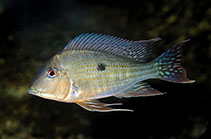
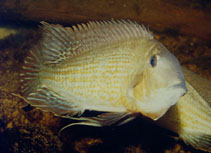
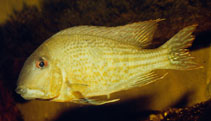
Klassifizierung / Names
Namen | Synonyme | Catalog of Fishes(Gattung, Arten) | ITIS | CoL | WoRMS | Cloffa
>
Cichliformes (Cichlids, convict blennies) >
Cichlidae (Cichlids) > Geophaginae
Etymology: Geophagus: Greek, gea = the earth + Greek, phagein = to eat (Ref. 45335).
More on author: Bloch.
Taxonomic Remarks
Redescription in Kullander & Nijssen (1986: 31), with bibliography, diagnosis, description, distribution, and illustrations.
Umwelt: Milieu / Klimazone / Tiefenbereich / Verbreitungsgebiet
Ökologie
; süßwasser benthopelagisch; pH range: 6.0 - 8.0; dH range: 5 - 19; standorttreu (Ref. 126106). Tropical; 22°C - 25°C (Ref. 1672)
South America: Saramacca and Suriname Rivers in Suriname; Marowijne River in Suriname and French Guiana.
Größe / Gewicht / Alter
Geschlechtsreife: Lm ? range ? - ? cm
Max length : 17.2 cm SL Männchen/unbestimmt; (Ref. 137577)
Though not so abundant, often caught in the quiet zones of cascades with G. harreri (Ref. 35237). Adults live in mud and sand-bottomed canals. Maximum length 30 cm TL (Ref. 5723). Omnivorous, with a tendency towards herbivory, searches for food by digging into the substrate with its protractile mouth. Can emit sounds through its pharyngeal teeth though it is not known whether it is a form of communication or not. Spawning takes place on a flat stone or in a hole dug in the sand. Parents generally take the eggs into their mouths until hatching occurs three days later. At night or when faced with danger, the alevins seeks shelter in the mother's mouth. Parents take care of their siblings for several weeks (Ref. 35237).
Lebenszyklus und Paarungsverhalten
Geschlechtsreife | Fortpflanzung | Ablaichen | Eier | Fruchtbarkeit | Larven
Parents form pairs. Larvophile mouthbrooder.
Kullander, S.O. and H. Nijssen, 1989. The cichlids of Surinam: Teleostei, Labroidei. E.J. Brill, Leiden, The Netherlands. 256 p. (Ref. 26372)
IUCN Rote Liste Status (Ref. 130435: Version 2025-2 (Global))
Bedrohung für Menschen
Harmless
Nutzung durch Menschen
Fischereien: kommerziell; Aquarium: Kommerziell
Tools
Zusatzinformationen
Download XML
Internet Quellen
Schätzungen auf der Grundlage von Modellen
Phylogenetischer Diversitätsindex (Ref.
82804): PD
50 = 0.5000 [Uniqueness, from 0.5 = low to 2.0 = high].
Bayesian length-weight: a=0.02455 (0.01347 - 0.04474), b=3.04 (2.89 - 3.19), in cm total length, based on LWR estimates for this species & Genus-body shape (Ref.
93245).
Trophische Ebene (Ref.
69278): 2.3 ±0.1 se; based on size and trophs of closest relatives
Widerstandsfähigkeit (Ref.
120179): mittel, Verdopplung der Population dauert 1,4 - 4,4 Jahre. (Fec=250).
Anfälligkeit der Fischerei (Ref.
59153): Low vulnerability (11 of 100).
🛈