Ambiente: milieu / zona climatica / distribuzione batimetrica / gamma di distribuzione
Ecologia
; acqua dolce benthopelagico; pH range: 6.5 - 7.5; dH range: ? - 15. Tropical; 21°C - 24°C (Ref. 2059)
South America: upper and central Amazon in Peru, Colombia and Brazil; rivers of the northern Suriname.
Dimensione / Peso / Età
Maturità: Lm ? range ? - ? cm
Max length : 4.2 cm SL maschio/sesso non determinato; (Ref. 79512)
Breve descrizione
Chiavi di identificazione | Morfologia | Morfometria
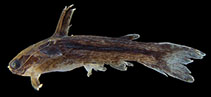
Spine dorsali (totale) : 1; Raggi dorsali molli (totale) : 3 - 5; Vertebre: 29 - 30. Can be diagnosed from all congeners by the following characters: reduced mesethmoid, wider than long, (mesethmoid length 12.1-15% HL; width 17.2-19% HL); lower jaw slightly protruding beyond upper; nasal ossified, tubular, not sutured to mesethmoid; third nuchal plate reduced; small prevomer, with short rostro-lateral process; elongate postcleithral process, sometimes as long as head length; ribs 5-6; and vertebrae, 29-30 (except Tatia galaxias, rarely having 30). Deferent duct externally elongate and anal-fin base swollen, with a thick secretory pouch in mature males. Can be further differentiated by the following combination of restricted characters: females with genital papilla; anal fin of mature males bearing rays with uncurved segments; and caudal fin lobes with about the same length in both adult females and males. Other distinguishing characters include whitish ground color pattern with brown spots, pattern mottled or with irregular stripes; ventral surface of head covered with short brown irregular stripes; body with a characteristic dark band along lateral line; and a small adult size of less than 4 cm SL (Ref. 79512).
This is typically associated with blackwater environment, mainly in rivers. In central Amazon, it occurs both in black and clear waters but only in dense vegetation where there is minimal light. Field data suggest that this fish inhabits water with low pH, low conductivity and low level of dissolved oxygen. Reaches sexual maturity above 2.8 cm SL (Ref. 79512).
Ciclo vitale e comportamento di accoppiamento
Maturità | Riproduzione | Deposizione | Uova | Fecondità | Larve
Sarmento-Soares, L.M. and R.F. Martins-Pinheiro, 2008. A systematic revision of Tatia (Siluriformes: Auchenipteridae: Centromochlinae). Neotrop. Ichthyol. 6(3):495-542. (Ref. 79512)
Stato della Lista Rossa IUCN (Ref. 130435: Version 2025-2 (Global))
Minaccia per l'uomo
Harmless
Usi umani
Strumenti
Rapporti speciali
Scarica XML
Fonti Internet
Stime basate su modelli
Indice di diversità filogenetica (Fonte Biblio.
82804): PD
50 = 0.5000 [Uniqueness, from 0.5 = low to 2.0 = high].
Bayesian length-weight: a=0.00490 (0.00199 - 0.01208), b=3.10 (2.88 - 3.32), in cm total length, based on LWR estimates for this (Sub)family-body shape (Ref.
93245).
Livello trofico (Fonte Biblio.
69278): 3.2 ±0.4 se; based on size and trophs of closest relatives
Vulnerabilità della pesca (Ref.
59153): Low vulnerability (10 of 100).
🛈