Ambiente: milieu / zona climatica / distribuzione batimetrica / gamma di distribuzione
Ecologia
; acqua dolce benthopelagico. Tropical
South America: Suriname and Marowijne River basins in Suriname; Maroni and Sinnamary River basins in French Guiana; Negro River drainage and at a single locality in Central Amazon basin in Brazil; Trombetas river drainage in Brazil.
Lunghezza alla prima maturità / Dimensione / Peso / Età
Maturità: Lm ?, range 7 - ? cm
Max length : 11.6 cm SL maschio/sesso non determinato; (Ref. 79512)
Breve descrizione
Chiavi di identificazione | Morfologia | Morfometria
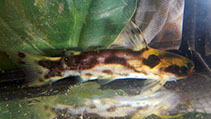
Spine dorsali (totale) : 1; Raggi dorsali molli (totale) : 5; Raggi anali molli: 10 - 11; Vertebre: 34 - 36. Diagnosed from all other species of Tatia by the following characters: male anal fin with sharp pointed tip; the first unbranched anal-fin ray divided into 3-4 segments; and the last branched ray reduced. Can be distinguished from most of its congeners, except Tatia aulopygia Tatia intermedia and Tatia gyrina, by having a wide mouth, width 54.0-59.7% HL (vs. 39.0-53.3% HL). Additional characteristics for recognition of Tatia brunnea are diagnostic in combination: nasal ossified with wide medial flanges partially sutured to lateral margin of mesethmoid; ribs 9-10; post-Weberian vertebrae 34-36. Other features useful for distinguishing Tatia brunnea include details in coloration, such as: border of mouth whitish, contrasting with dark head; posterior border of nuchal shield usually whitish or pale; pectoral-fin spine usually with transverse bands; caudal fin usually whitish with scattered dark brown blotches; and head width 86.6-93.4% HL (Ref. 79512).
Body shape (shape guide): short and / or deep.
Sympatric with Tatia intermedia in some rivers in Suriname and French Guiana and also in the Trombetas river (Ref. 79512). Rather rare, occurs in the slow parts of creeks. May easily be mistaken as juveniles of Glanidium leopardus with which it is distinguished by means of the pectoral spines (having projections vs. smooth) and by the number of rays in the anal fin (8-9 vs. 12-14). Sexual dimorphism in males appear at a length of 3.5-4.0 cm. Its small size makes it interesting for aquarists (Ref. 35381). Reported sizes at sexual maturity are above 5.46 cm SL and above 7.0 cm SL (Ref. 79512).
Ciclo vitale e comportamento di accoppiamento
Maturità | Riproduzione | Deposizione | Uova | Fecondità | Larve
Sarmento-Soares, L.M. and R.F. Martins-Pinheiro, 2008. A systematic revision of Tatia (Siluriformes: Auchenipteridae: Centromochlinae). Neotrop. Ichthyol. 6(3):495-542. (Ref. 79512)
Stato della Lista Rossa IUCN (Ref. 130435: Version 2025-2 (Global))
Minaccia per l'uomo
Harmless
Usi umani
Strumenti
Rapporti speciali
Scarica XML
Fonti Internet
Stime basate su modelli
Indice di diversità filogenetica (Fonte Biblio.
82804): PD
50 = 0.5000 [Uniqueness, from 0.5 = low to 2.0 = high].
Bayesian length-weight: a=0.01995 (0.00906 - 0.04395), b=3.01 (2.83 - 3.19), in cm total length, based on all LWR estimates for this body shape (Ref.
93245).
Livello trofico (Fonte Biblio.
69278): 3.4 ±0.4 se; based on size and trophs of closest relatives
Resilienza (Fonte Biblio.
120179): Alto, tempo minimo di raddoppiamento della popolazione meno di 15 mesi (Preliminary K or Fecundity.).
Vulnerabilità della pesca (Ref.
59153): Low vulnerability (10 of 100).
🛈