Elasmobranchii (Haie und Rochen) (sharks and rays) >
Rajiformes (Skates and rays) >
Gurgesiellidae (Pygmy skates)
Etymology: Cruriraja: Latin, crur, cruris = pertaining to a leg + Latin, raja = a ray (Raja sp) (Ref. 45335).
Eponymy: This is named after the Woods Hole Oceanographic Institute research vessel ‘Atlantis’, which collected three new species of skates along the coasts of Cuba, including this one. (Ref. 128868), visit book page.
Umwelt: Milieu / Klimazone / Tiefenbereich / Verbreitungsgebiet
Ökologie
seewasser bathydemersal; tiefenbereich 512 - 778 m (Ref. 26282). Deep-water
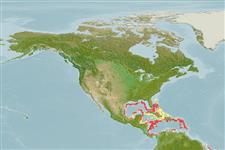
Western Central Atlantic: Florida, USA to northern Cuba.
Größe / Gewicht / Alter
Geschlechtsreife: Lm ? range ? - ? cm
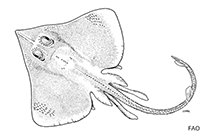
Large width interspace between first and second dorsal fins. Upper surface pale brown disc without definite markings. Lower surface whitish or yellowish. Tail pale dusky below (Ref. 6902).
Body shape (shape guide): other.
Deep water species (Ref. 6902). Oviparous (Ref. 50449). Eggs have horn-like projections on the shell (Ref. 205).
Lebenszyklus und Paarungsverhalten
Geschlechtsreife | Fortpflanzung | Ablaichen | Eier | Fruchtbarkeit | Larven
Oviparous, paired eggs are laid. Embryos feed solely on yolk (Ref. 50449). Eggs have horn-like projections on the shell (Ref. 205).
McEachran, J.D. and K.A. Dunn, 1998. Phylogenetic analysis of skates, a morphologically conservative clade of elasmobranchs (Chondrichthyes: Rajidae). Copeia 1998(2):271-290. (Ref. 27314)
IUCN Rote Liste Status (Ref. 130435: Version 2025-2 (Global))
Bedrohung für Menschen
Harmless
Nutzung durch Menschen
Fischereien: bycatch
Tools
Zusatzinformationen
Download XML
Internet Quellen
Schätzungen auf der Grundlage von Modellen
Bevorzugte Temperatur (Ref.
123201): 7.4 - 13.7, mean 9.5 °C (based on 24 cells).
Phylogenetischer Diversitätsindex (Ref.
82804): PD
50 = 0.5039 [Uniqueness, from 0.5 = low to 2.0 = high].
Bayesian length-weight: a=0.00661 (0.00227 - 0.01925), b=2.95 (2.71 - 3.19), in cm total length, based on LWR estimates for this (Sub)family-body shape (Ref.
93245).
Trophische Ebene (Ref.
69278): 3.8 ±0.6 se; based on size and trophs of closest relatives
Widerstandsfähigkeit (Ref.
120179): niedrig, Verdopplung der Population dauert 4,5 - 14 Jahre. (Fec assumed to be <100).
Anfälligkeit der Fischerei (Ref.
59153): Low to moderate vulnerability (35 of 100).
🛈