Classification / Noms
Noms communs | Synonymes | Catalog of Fishes(Genre, Espèce) | ITIS | CoL | WoRMS | Cloffa
>
Cypriniformes (Carps) >
Cyprinidae (Minnows or carps) > Cyprininae
Etymology: schwanefeldii: Named for military surgeon H. W. Schwanefeld, who collected the type series.
Eponymy: Lieutenant Colonel H W Schwanefeld was a Dutch military surgeon. He collected both of the types in West Sumatra. Bleeker misspelled his name in the binomials; a mistake he subsequently corrected but the original spelling must, by convention, be retained. (Ref. 128868), visit book page.
More on author: Bleeker.
Environnement : milieu / zone climatique / profondeur / gamme de distribution
Écologie
; eau douce benthopélagique; pH range: 6.5 - 7.0; dH range: ? - 10; potamodrome (Ref. 126106). Tropical; 22°C - 25°C (Ref. 13371); 16°N - 4°S
Asia: Mekong and Chao Phraya basins, Malay Peninsula, Sumatra and Borneo.
Taille / Poids / Âge
Maturité: Lm ? range ? - ? cm
Max length : 35.0 cm SL mâle / non sexé; (Ref. 30857); common length : 20.0 cm SL mâle / non sexé; (Ref. 4835)
Description synthétique
Clés d'identification | Morphologie | Morphométrie
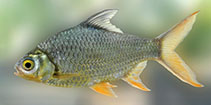
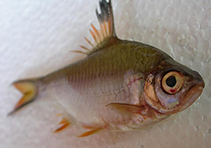
Épines dorsales (Total) : 3; Rayons mous dorsaux (Total) : 8; Épines anales: 3; Rayons mous anaux: 5. Distinguished from other species of the genus in having a red dorsal fin with a black blotch at the tip, red pectoral, pelvic and anal fins, red caudal fin with white margin and a black submarginal stripe along each lobe, and 8 scale rows between dorsal-fin origin and lateral line (Ref. 27732). Large individuals silvery or golden yellow in life with its dorsal fin red and caudal fin orange or blood-red (Ref. 2091).
Body shape (shape guide): fusiform / normal; Cross section: oval.
Found in rivers, streams, canals and ditches (Ref. 12693). Adults occur in medium to large-sized rivers and enters flooded fields (Ref. 12975). In east Kalimantan, Indonesia a temperature range of 20.4-33.7°C was recorded for this species (Ref. 6129). Largely herbivorous, consuming aquatic macrophytes and submerged land plants, as well as filamentous algae and occasionally insects (Ref. 12693). They also feedson small fishes (Ref. 12693), worms and crustaceans (Ref. 7020). Migratory behaviour is undetermined (Ref. 126106). Usually marketed fresh (Ref. 12693).
Cycle de vie et comportement reproducteur
Maturité | Reproduction | Frai | Œufs | Fécondité | Larves
Kottelat, M., A.J. Whitten, S.N. Kartikasari and S. Wirjoatmodjo, 1993. Freshwater fishes of Western Indonesia and Sulawesi. Periplus Editions, Hong Kong. 221 p. (Ref. 7050)
Statut dans la liste rouge de l'IUCN (Ref. 130435: Version 2025-2 (Global))
Menace pour l'homme
Harmless
Utilisations par l'homme
Pêcheries: pêcheries vivrières; Aquaculture: commercial; Aquarium: Commercial; appât: occasionally
Outils
Articles particuliers
Télécharger en XML
Sources Internet
Estimations basées sur des modèles
Indice de diversité phylogénétique (Réf.
82804): PD
50 = 0.5156 [Uniqueness, from 0.5 = low to 2.0 = high].
Bayesian length-weight: a=0.01023 (0.00665 - 0.01574), b=3.01 (2.89 - 3.13), in cm total length, based on LWR estimates for this species & (Sub)family-body (Ref.
93245).
Niveau trophique (Réf.
69278): 3.0 ±0.0 se; based on diet studies.
Résilience (Réf.
120179): Haut, temps minimum de doublement de population inférieur à 15 mois (Assuming tm=1; Fec=8,000-16,000).
Vulnérabilité de la pêche (Ref.
59153): Low to moderate vulnerability (33 of 100).
🛈
Nutriments (Ref.
124155): Calcium = 242 [120, 656] mg/100g; Iron = 0.861 [0.502, 1.668] mg/100g; Protein = 16.6 [15.4, 18.0] %; Omega3 = 0.498 [0.216, 1.153] g/100g; Selenium = 65.7 [29.7, 135.9] μg/100g; VitaminA = 41.2 [13.7, 137.9] μg/100g; Zinc = 1.33 [0.77, 2.10] mg/100g (wet weight);