Milieu: milieu / Klimaatzone / Diepte / verspreidingsgebied
Ecologie
; zoet water benthopelagisch; pH range: 6.0 - 8.0; dH range: 4 - 25; potamodroom (Ref. 51243). Tropical; 20°C - 26°C (Ref. 2060); 11°N - 35°S, 85°W - 35°W
Central and South America: Costa Rica to Argentina in most rivers basins.
Lengte bij maturiteit / Grootte / Gewicht / Leeftijd
Maturiteit: Lm ?, range 17 - ? cm
Max length : 65.0 cm TL mannelijk / geslacht onbekend; (Ref. 111518); max. gepubliceerd gewicht: 3.8 kg (Ref. 111518)
Korte beschrijving
Determinatiesleutels | Morfologie | Morfometrie
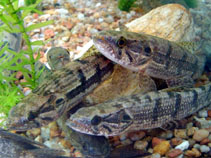
Occurs in diverse habitats from free flowing clear water streams, well up into the valleys, to slow turbid waters, water courses, irrigation and drainage ditches, and ponds on the plains (Ref. 11225). Rests in vegetation during the day and is active at night (Ref. 6858). Adults feed on fish; juveniles feed on crustacean and insect larvae (Ref. 26543), shrimps and other small invertebrates (Ref. 12225). Spawn in pits located in shallow water at a temperature of about 26°C (Ref. 205). Males guard the nests even after the eggs have hatched (Ref. 205). Reaches more than 3 kg (Mark Fitzgerald, pers. comm., 2001). Live fish are difficult to handle and potentially dangerous because of their sharp teeth, strong jaws, and slippery bodies.
Eggs are fertilized in the cupped anal fin of the female. When the eggs get sticky, they are dropped into a pit which will be guarded by the male even until after the eggs have hatched (Ref. 205).
Planquette, P., P. Keith and P.-Y. Le Bail, 1996. Atlas des poissons d'eau douce de Guyane. Tome 1. Collection du Patrimoine Naturel Volume 22, MNHN, Paris & INRA, Paris. 429 p. (Ref. 12225)
Status op de Rode Lijst van het IUCN (Ref. 130435: Version 2025-2 (Global))
Gevaar voor de mens
Other
Gebruik door de mens
Visserij: commercieel; Aquacultuur: commercieel; sportvis: ja; Aquarium: Publieke aquaria
Tools
Speciale rapporten
Download XML
Internetbronnen
Schattingen op basis van modellen
Fylogenetische diversiteitsindex (Ref.
82804): PD
50 = 0.5000 [Uniqueness, from 0.5 = low to 2.0 = high].
Bayesian length-weight: a=0.00891 (0.00750 - 0.01059), b=3.10 (3.05 - 3.15), in cm total length, based on LWR estimates for this species (Ref.
93245).
Trofisch niveau (Ref.
69278): 4.5 ±0.0 se; based on diet studies.
Weerstandsvermogen (Ref.
120179): laag, minimale populatieverdubbelingstijd 4,5-14 jaar (K=0.08).
Kwetsbaarheid van de visserij (Ref.
59153): High to very high vulnerability (66 of 100).
🛈
Voedingsstoffen (Ref.
124155): Calcium = 61.6 [25.6, 142.6] mg/100g; Iron = 1.1 [0.6, 2.5] mg/100g; Protein = 18.2 [16.2, 20.4] %; Omega3 = 0.324 [0.133, 0.812] g/100g; Selenium = 90.5 [35.2, 203.6] μg/100g; VitaminA = 65.9 [24.2, 183.1] μg/100g; Zinc = 1.1 [0.8, 1.5] mg/100g (wet weight);