Environnement : milieu / zone climatique / profondeur / gamme de distribution
Écologie
; eau douce; saumâtre benthopélagique; pH range: 7.0 - ? ; dH range: 15 - ?; profondeur 0 - 10 m (Ref. 6898). Tropical; 18°C - 22°C (Ref. 2059)
Asia: China, North and South Korea, Hong Kong, Japan and Amur River basin (Ref. 1441) to Red River drainages; Mongolia (Ref. 57778). Several countries report adverse ecological impact after introduction. Introduced in Iran (Ref. 39702).
Longueur à la première maturité / Taille / Poids / Âge
Maturité: Lm 10.3, range 9 - 13 cm
Max length : 29.0 cm TL mâle / non sexé; (Ref. 128900); common length : 16.9 cm SL mâle / non sexé; (Ref. 35840); poids max. publié: 232.30 g (Ref. 128900)
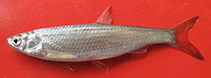
Épines dorsales (Total) : 3; Rayons mous dorsaux (Total) : 7; Épines anales: 3; Rayons mous anaux: 11 - 13. Completed lateral line, went downward suddenly at the pectoral fin, forming an angle, going upward along the anal fin, till the middle of the caudal fin. Green gray in the back, white in the stomach (Ref. 33303).
Body shape (shape guide): fusiform / normal.
The species is common in large streams and reservoirs in Hong Kong but not favored as a table fish because the flesh is unpalatable and very bony; abundant in China where it is canned. The main bulk of the diet includes zooplankton, insects, crustaceans, algae and detritus.
Cycle de vie et comportement reproducteur
Maturité | Reproduction | Frai | Œufs | Fécondité | Larves
Berg, L.S., 1964. Freshwater fishes of the U.S.S.R. and adjacent countries. volume 2, 4th edition. Israel Program for Scientific Translations Ltd, Jerusalem. (Russian version published 1949). (Ref. 1441)
Statut dans la liste rouge de l'IUCN (Ref. 130435: Version 2025-2 (Global))
Menace pour l'homme
Potential pest
Utilisations par l'homme
Pêcheries: intérêt commercial mineur; pêche sportive: oui
Outils
Articles particuliers
Télécharger en XML
Sources Internet
Estimations basées sur des modèles
Indice de diversité phylogénétique (Réf.
82804): PD
50 = 0.5039 [Uniqueness, from 0.5 = low to 2.0 = high].
Bayesian length-weight: a=0.00661 (0.00580 - 0.00753), b=3.08 (3.04 - 3.12), in cm total length, based on LWR estimates for this species (Ref.
93245).
Niveau trophique (Réf.
69278): 2.8 ±0.32 se; based on food items.
Résilience (Réf.
120179): Milieu, temps minimum de doublement de population : 1,4 à 4,4 années (tm=3).
Vulnérabilité de la pêche (Ref.
59153): Moderate vulnerability (43 of 100).
🛈