Klassifizierung / Names
Namen | Synonyme | Catalog of Fishes(Gattung, Arten) | ITIS | CoL | WoRMS | Cloffa
Umwelt: Milieu / Klimazone / Tiefenbereich / Verbreitungsgebiet
Ökologie
; süßwasser benthopelagisch; pH range: 7.0 - ? ; dH range: 20 - ?. Temperate; 10°C - 24°C (Ref. 2059)
Asia: China, Korea, Japan and Amur River basin. At least one country reports adverse ecological impact after introduction.
Länge bei der ersten Reifung / Größe / Gewicht / Alter
Geschlechtsreife: Lm ?, range 20 - ? cm
Max length : 47.0 cm TL Männchen/unbestimmt; (Ref. 1441); 34.3 cm TL (female); common length : 26.0 cm TL Männchen/unbestimmt; (Ref. 56557); max. veröff. Gewicht: 1.7 kg (Ref. 56557)
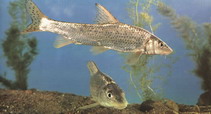
Wirbelzahl: 42 - 44. Both sides of the body with 7-11 large and blackish spots. Deep body with clearly convex dorsal profile. Head length shorter than body depth. Snout length shorter or equal to postorbital head length. Lips not developed, lateral lobes of lower lip narrow, without folds, the median process large and marked. Barbel length slightly thick, 1/2-2/3 of eye diameter. Dorsal spine strong, equal to HL. Origin of dorsal fin nearer the tip of snout than the caudal base (Ref. 38453). Anal fin with 6 1/2 branched anal rays; last simple dorsal ray ossified, spine-like (Ref. 43281).
Body shape (shape guide): fusiform / normal.
Adults usually found in streams and creeks with moderate flow and sandy bottom (Ref. 43281). Feed mainly on insects and mollusks in summer and on crustaceans in winter (Ref. 1441)
Mature at 3 years of age. Spawns from May to June, with water temperatures from 19-25 C°. Eggs are pasted at underwater plants. Egg diameter about 2mm. Development time about 4 days. Larvae live pelagic for the first 6 days.
Kottelat, M., 2006. Fishes of Mongolia. A check-list of the fishes known to occur in Mongolia with comments on systematics and nomenclature. The World Bank, Washington, DC. 103 p. (Ref. 57778)
IUCN Rote Liste Status (Ref. 130435: Version 2025-2 (Global))
Bedrohung für Menschen
Potential pest (Ref. 43281)
Nutzung durch Menschen
Fischereien: kommerziell
Tools
Zusatzinformationen
Download XML
Internet Quellen
Schätzungen auf der Grundlage von Modellen
Phylogenetischer Diversitätsindex (Ref.
82804): PD
50 = 0.5002 [Uniqueness, from 0.5 = low to 2.0 = high].
Bayesian length-weight: a=0.00794 (0.00659 - 0.00958), b=3.13 (3.08 - 3.18), in cm total length, based on LWR estimates for this species (Ref.
93245).
Trophische Ebene (Ref.
69278): 3.5 ±0.47 se; based on food items.
Widerstandsfähigkeit (Ref.
120179): mittel, Verdopplung der Population dauert 1,4 - 4,4 Jahre. (tm=3).
Anfälligkeit der Fischerei (Ref.
59153): Moderate vulnerability (37 of 100).
🛈