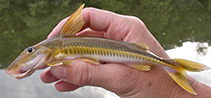
>
Siluriformes (Catfishes) >
Doradidae (Thorny catfishes) > Doradinae
Etymology: Leptodoras: Greek, leptos = thin + Greek, doras = skin (Ref. 45335).
Eponymy: George Linnell was an executive of the Essequibo Exploring Company. He provided Eigenmann with boats and crewmen for his expedition to British Guiana (Guyana). (Ref. 128868), visit book page.
More on author: Eigenmann.
Ambiente: milieu / zona climatica / distribuzione batimetrica / gamma di distribuzione
Ecologia
; acqua dolce demersale; pH range: 5.8 - 7.0; dH range: ? - 18. Tropical; 18°C - 22°C (Ref. 2060)
South America: Upper Orinoco (rios Ventuari and Mavaca) and Casiquiare River basin in Venezuela; Atlantic Coast drainages of the Guianas and northern Brazil such as Essequibo, Demerara and Araguari); the rios Uatumã, Tacutu and Demini in Brazil (Ref. 56896). Recently collected from the rio Tiquié basin (right bank tributary of the upper rio Negro) in the Amazonas State and from the upper rio Aripuaña (tributary of the rio Madeira) in Mato Grosso State, Brazil, extending the known distribution of this species into the western limits of the Brazilian Shield (Ref. 79526).
Dimensione / Peso / Età
Maturità: Lm ? range ? - ? cm
Max length : 23.0 cm SL maschio/sesso non determinato; (Ref. 37054)
Breve descrizione
Chiavi di identificazione | Morfologia | Morfometria
Spine dorsali (totale) : 1; Raggi dorsali molli (totale) : 6; Raggi anali molli: 12 - 16. Upper labial extension very elongate, straight to weakly curved medially and nearly uniform in width with a bluntly rounded tip. Differs further from all Leptodoras except L. acipenserinus by having an adipose fin extending anteriorly as a low thin ridge to a point midway between the anterior insertion of the adipose fin and the posterior insertion of the dorsal fin. Distinguished from L. acipenserinus by a number of characters including a relatively longer predorsal distance (35.5-38.7% SL), inner flap of gill opening incomplete, lower sum of midlateral plates (74-81), anal-fin shape (tip of longest branched ray falls short of vertical through tip of last branched ray in extended anal fin and is more or less even with vertical through base of last ray; line defined by tips angled anteriorly, forming a 45-90° angle with long axis of body), pectoral-fin spine length 19.9-26.2% of SL and pectoral-fin spine dentation with teeth strongly retrorse along majority of posterior margin, becoming less retrorse distally, size relatively uniform along distal half, last denticulation usually subterminal (Ref. 56896).
Body shape (shape guide): elongated.
Ciclo vitale e comportamento di accoppiamento
Maturità | Riproduzione | Deposizione | Uova | Fecondità | Larve
Sabaj, M.H. and C.J. Ferraris Jr., 2003. Doradidae (Thorny catfishes). p. 456-469. In R.E. Reis, S.O. Kullander and C.J. Ferraris, Jr. (eds.) Checklist of the Freshwater Fishes of South and Central America. Porto Alegre: EDIPUCRS, Brasil. (Ref. 37054)
Stato della Lista Rossa IUCN (Ref. 130435: Version 2025-2 (Global))
Minaccia per l'uomo
Harmless
Usi umani
Strumenti
Rapporti speciali
Scarica XML
Fonti Internet
Stime basate su modelli
Indice di diversità filogenetica (Fonte Biblio.
82804): PD
50 = 0.5002 [Uniqueness, from 0.5 = low to 2.0 = high].
Bayesian length-weight: a=0.01230 (0.00587 - 0.02579), b=2.96 (2.78 - 3.14), in cm total length, based on LWR estimates for this (Sub)family-body shape (Ref.
93245).
Livello trofico (Fonte Biblio.
69278): 2.8 ±0.4 se; based on size and trophs of closest relatives
Resilienza (Fonte Biblio.
120179): Alto, tempo minimo di raddoppiamento della popolazione meno di 15 mesi (Preliminary K or Fecundity.).
Vulnerabilità della pesca (Ref.
59153): Low vulnerability (18 of 100).
🛈