Klassifizierung / Names
Namen | Synonyme | Catalog of Fishes(Gattung, Arten) | ITIS | CoL | WoRMS | Cloffa
>
Cyprinodontiformes (Rivulines, killifishes and live bearers) >
Poeciliidae (Poeciliids) > Poeciliinae
Etymology: Priapichthys: Taken from Priapus, the Greek, and Roman god of procreation in the mithology and also = a phallus; diminutive + Greek, ichthys = fish (Ref. 45335).
Eponymy: This is not a true eponym as it is after Priapus, the Greek god of fertility. [...] (Ref. 128868), visit book page.
More on author: Regan.
Umwelt: Milieu / Klimazone / Tiefenbereich / Verbreitungsgebiet
Ökologie
; süßwasser benthopelagisch. Tropical; 17°C - 35°C (Ref. 36880)
Central America: Costa Rica. Two subspecies were previously recognized: Priapichthys annectens annectens of the Atlantic drainage and Priapichthys annectens hesperis of the Río Tárcoles drainage on the Pacific drainage.
Größe / Gewicht / Alter
Geschlechtsreife: Lm ? range ? - ? cm
Max length : 4.0 cm TL Männchen/unbestimmt; (Ref. 26130); 6.5 cm SL (female); max. veröff. Gewicht: 2.56 g (Ref. 126949)
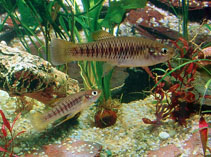
Scales bordered in black which gives a cross-hatch pattern to the body, more intense along the midline of the side and sometimes resembles a series of X's along the body, The sides with 6 - 12 vertical bars, more conspicuous on the urosome and the intensity varies according to the geographical region of the population. Black elongate blotches present on the membranes of the dorsal fin base. First anal fin rays orange; other fins colorless. Eyes and cheeks reflect silvery green highlights (Ref. 36880).
Body shape (shape guide): elongated; Cross section: oval.
Lives in currents of low to high velocity; in brooks and streams between 25-1270 m elevation; in temperatures of 17-35°C. Swims in small groups at all depths, over rock or sand substrata. Reproduces continuously all year round. Feeds on terrestrial and aquatic insects, especially ants and termites (Ref. 36880).
Lebenszyklus und Paarungsverhalten
Geschlechtsreife | Fortpflanzung | Ablaichen | Eier | Fruchtbarkeit | Larven
Wischnath, L., 1993. Atlas of livebearers of the world. T.F.H. Publications, Inc., United States of America. 336 p. (Ref. 26130)
IUCN Rote Liste Status (Ref. 130435: Version 2025-2 (Global))
Bedrohung für Menschen
Harmless
Nutzung durch Menschen
Tools
Zusatzinformationen
Download XML
Internet Quellen
Schätzungen auf der Grundlage von Modellen
Phylogenetischer Diversitätsindex (Ref.
82804): PD
50 = 0.5078 [Uniqueness, from 0.5 = low to 2.0 = high].
Bayesian length-weight: a=0.00912 (0.00461 - 0.01803), b=3.14 (2.97 - 3.31), in cm total length, based on LWR estimates for this species & (Sub)family-body (Ref.
93245).
Trophische Ebene (Ref.
69278): 3.4 ±0.46 se; based on food items.
Widerstandsfähigkeit (Ref.
120179): mittel, Verdopplung der Population dauert 1,4 - 4,4 Jahre. (Preliminary K or Fecundity.).
Anfälligkeit der Fischerei (Ref.
59153): Low vulnerability (10 of 100).
🛈