Klassifizierung / Names
Namen | Synonyme | Catalog of Fishes(Gattung, Arten) | ITIS | CoL | WoRMS | Cloffa
Taxonomic Remarks
Placed in the genus Trichopodus in Ref. 87121.
Umwelt: Milieu / Klimazone / Tiefenbereich / Verbreitungsgebiet
Ökologie
; süßwasser demersal; pH range: 6.0 - 7.0; dH range: 2 - 25. Tropical; 26°C - 30°C (Ref. 1672)
Asia: originally occurring in the Mekong in Cambodia and Viet Nam and Chao Phraya basins (Ref. 43281). Introduced in the Mekong basin in Thailand and expected in Laos (Ref. 43281). A popular aquarium species which appeared in Colombia because of escapes from aquarium rearing facilities (Ref. 1739).
Größe / Gewicht / Alter
Geschlechtsreife: Lm ? range ? - ? cm
Max length : 14.0 cm TL Männchen/unbestimmt; (Ref. 43281)
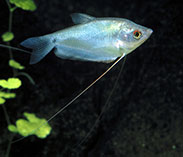
Rückenflossenstacheln (insgesamt) : 3 - 4. Trichopodus microlepis is distinguished from other congeners by having the following characters: body silvery or grey without distinct markings; dorsal fin with 3-4 spines; 57-65 scales on lateral line; 34-40 transverse scales; and length of dorsal-fin base 14.5-17.3% SL (Ref. 97359).
Body shape (shape guide): short and / or deep.
Obligate air-breathing (Ref. 126274); Found in ponds and swamps (Ref. 43281). Occurs in shallow sluggish or standing water habitats with a lot of aquatic vegetation. Common in the floodplain of the lower Mekong. Feeds on zooplankton, crustaceans and aquatic insects (Ref. 12693). An air-breathing species (Ref. 118402). Marketed fresh (Ref. 12693).
Lebenszyklus und Paarungsverhalten
Geschlechtsreife | Fortpflanzung | Ablaichen | Eier | Fruchtbarkeit | Larven
Builds bubble nest. Produces 500-1000 eggs.
Kottelat, M., 2013. The fishes of the inland waters of Southeast Asia: a catalogue and core bibliography of the fishes known to occur in freshwaters, mangroves and estuaries. The Raffles Bulletin of Zoology 2013 (Suppl. 27):1-663. (Ref. 94476)
IUCN Rote Liste Status (Ref. 130435: Version 2025-2 (Global))
Bedrohung für Menschen
Harmless
Nutzung durch Menschen
Fischereien: weniger kommerziell; Aquarium: hoch kommerziell
Tools
Zusatzinformationen
Download XML
Internet Quellen
Schätzungen auf der Grundlage von Modellen
Phylogenetischer Diversitätsindex (Ref.
82804): PD
50 = 0.5156 [Uniqueness, from 0.5 = low to 2.0 = high].
Bayesian length-weight: a=0.01413 (0.00674 - 0.02961), b=3.00 (2.82 - 3.18), in cm total length, based on LWR estimates for this species & (Sub)family-body (Ref.
93245).
Trophische Ebene (Ref.
69278): 3.4 ±0.40 se; based on food items.
Widerstandsfähigkeit (Ref.
120179): mittel, Verdopplung der Population dauert 1,4 - 4,4 Jahre. (Fec=500-1000 egss (Ref.
1672)).
Anfälligkeit der Fischerei (Ref.
59153): Low vulnerability (10 of 100).
🛈
Nährstoffe (Ref.
124155): Calcium = 98 [46, 511] mg/100g; Iron = 1.53 [0.69, 3.30] mg/100g; Protein = 19 [17, 21] %; Omega3 = 0.284 [0.111, 0.769] g/100g; Selenium = 28.3 [11.2, 67.4] μg/100g; VitaminA = 33.2 [7.7, 153.6] μg/100g; Zinc = 2.52 [1.22, 4.69] mg/100g (wet weight); based on
nutrient studies.