>
Blenniiformes (Blennies) >
Chaenopsidae (Pike-, tube- and flagblennies)
Etymology: Acanthemblemaria: Greek, akantha = thorn + Greek, emblema, -atos, anything that is nailed, knocked in; also anything with bass or high relief (Ref. 45335).
Environnement : milieu / zone climatique / profondeur / gamme de distribution
Écologie
marin récifal. Tropical
Western Atlantic: Colombia.
Taille / Poids / Âge
Maturité: Lm ? range ? - ? cm
Max length : 4.3 cm SL mâle / non sexé; (Ref. 51458)
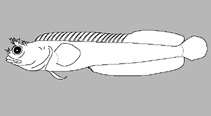
Épines anales: 2. Species distinguished by: large, eye-diameter sized dark blotch on side of head posterior to eye; dorsal fin consisting of spines and segmented rays; total dorsal-fin elements 29 to 40; two or more rows of teeth on each palatine bone; top of head often spiny; patch of cranial spines on nape ends anterior to supratemporal commissural pore; inner rim of posterior infraorbital bone smooth; supraorbital cirrus moderately to strongly branched, cranial spines not short and blunt. Common amongst Chaenopsids: small elongate fishes; largest species about 12 cm SL, most under 5 cm SL. Head usually with cirri or fleshy flaps on anterior nostrils, eyes, and sometimes laterally on nape; gill membranes continuous with each other across posteroventral surface of head. Each jaw with canine-like or incisor-like teeth anteriorly; teeth usually also present on vomer and often on palatines (roof of mouth). Dorsal-fin spines flexible, usually outnumbering the segmented soft rays (numbering 7 to 37), spinous and segmented-rayed portions forming a single, continuous fin; 2 flexible spines in anal fin; pelvic fins inserted anterior to position of pectoral fins, with 1 spine not visible externally and only 2 or 3 segmented (soft) rays; all fin rays, including caudal-fin rays, unbranched (simple). Lateral line absent. Scales absent (Ref.52855).
Body shape (shape guide): elongated.
Oviparous (Ref. 56066). Eggs are attached to the walls of the parent's shelter and are brooded by the male parent (Ref. 56066).
Cycle de vie et comportement reproducteur
Maturité | Reproduction | Frai | Œufs | Fécondité | Larves
Oviparous (Ref. 56066). Males guard the eggs until they hatch (Ref. 56066). Also Ref. 101194.
Acero, A.P., 1985. Zoogeographical implications of the distribution of selected families of Caribbean coral reef fishes. Proc. of the Fifth International Coral Reef Congress, Tahiti, Vol. 5. (Ref. 26280)
Statut dans la liste rouge de l'IUCN (Ref. 130435: Version 2025-2 (Global))
Menace pour l'homme
Harmless
Utilisations par l'homme
Outils
Articles particuliers
Télécharger en XML
Sources Internet
Estimations basées sur des modèles
Indice de diversité phylogénétique (Réf.
82804): PD
50 = 0.5000 [Uniqueness, from 0.5 = low to 2.0 = high].
Bayesian length-weight: a=0.00525 (0.00224 - 0.01232), b=3.07 (2.86 - 3.28), in cm total length, based on LWR estimates for this (Sub)family-body shape (Ref.
93245).
Niveau trophique (Réf.
69278): 3.4 ±0.4 se; based on size and trophs of closest relatives
Vulnérabilité de la pêche (Ref.
59153): Low vulnerability (10 of 100).
🛈