Holocéfalos (quimeras) (chimaeras) >
Chimaeriformes (Chimaeras) >
Callorhinchidae (Plownose chimaeras)
Etymology: Callorhinchus: Tautonymous with Chimaera callorynchus Linnaeus 1758 (but unnecessarily emended from -rynchus to -rhinchus: callum (L.), hard skin; rhynchus (L.), snout, referring to peculiar hoe-shaped proboscis (See ETYFish); milii: In honor of Bory de Saint-Vincent’s “old friend” (translation) Pierre Bernard Milius (1773‒1829), a French naval officer, naturalist and civil servant, who supplied specimen upon which description and its accompanying illustration (shown here) were based; (See ETYFish).
Eponymy: Baron Pierre Bernard Milius (1773–1829) was a French naval officer, naturalist and civil servant who took part in an exploratory voyage (1804) of the Mascarene Islands, Indian Ocean, under Nicolas Baudin, during which he became friends with Bory. [...] (Ref. 128868), visit book page.
Entorno: milieu / zona climática / rango de profundidad / gama de distribución
Ecología
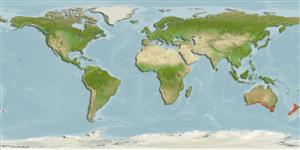
marino; salobre demersal; oceanodromo (Ref. 51243); rango de profundidad 0 - 227 m (Ref. 26346). Subtropical; 33°S - 50°S
Southwest Pacific: southern Australia and New Zealand.
Longitud en la primera madurez / Tamaño / Peso / Edad
Madurez: Lm 71.0, range 70 - ? cm
Max length : 125 cm TL macho / no sexado; (Ref. 26346); common length : 75.0 cm TL macho / no sexado; (Ref. 9258)
Descripción breve
Claves de identificación | Morfología | Morfometría
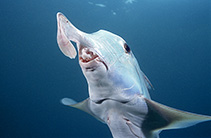
Occurs on continental shelves to depths of at least 200 m (Ref. 6871). Migrates into large estuaries and inshore bays in the spring to breed (Ref. 6871). Feeds mainly on shellfish (Ref. 26346). Oviparous (Ref. 50449). Eggs are encased in horny shells (Ref. 205). Flesh is of good eating quality. Males have a small, club-like protuberance on the head and also long copulation organs near the pelvic fins (Ref. 557).
Ciclo vital y comportamiento de apareamiento
Madurez | Reproducción | Puesta | Huevos | Fecundidad | Larva
Migrates into large estuaries and inshore bays in the spring to breed (Ref. 6871). Oviparous, two egg cases (Ref. 26346) are laid on sandy or muddy bottoms and take up to 8 months to hatch (Ref. 6871). Embryos feed solely on yolk (Ref. 50449).Young hatch at about 15 cm (Ref. 26346).
Last, P.R. and J.D. Stevens, 1994. Sharks and rays of Australia. CSIRO, Australia. 513 p. (Ref. 6871)
Situación en la Lista Roja de la UICN (Ref. 130435: Version 2025-2 (Global))
Amenaza para el ser humano
Harmless
Usos humanos
Pesquerías: comercial
Herramientas
Informes especiales
Descargar XML
Fuentes de Internet
Estimaciones basadas en modelos
Temperatura preferida (Referencia
123201): 12.1 - 18.2, mean 15.2 °C (based on 179 cells).
Índice de diversidad filogenética (Referencia
82804): PD
50 = 0.7500 [Uniqueness, from 0.5 = low to 2.0 = high].
Bayesian length-weight: a=0.00479 (0.00194 - 0.01180), b=3.13 (2.91 - 3.35), in cm total length, based on LWR estimates for this species & (Sub)family-body (Ref.
93245).
Nivel trófico (Referencia
69278): 3.6 ±0.29 se; based on food items.
Resiliencia (Referencia
120179): Bajo, población duplicada en un tiempo mínimo de 4.5-14 años (K=0.06-0.47; tm=2-6; Fec=2).
Vulnerabilidad pesquera (Ref.
59153): High vulnerability (55 of 100).
🛈
Vulnerabilidad climática (Ref.
125649): Very high vulnerability (83 of 100).
🛈
Nutrientes (Ref.
124155): Calcium = 25.5 [6.4, 69.6] mg/100g; Iron = 0.758 [0.284, 2.957] mg/100g; Protein = 14.3 [11.2, 18.8] %; Omega3 = 0.258 [0.116, 0.579] g/100g; Selenium = 32 [9, 84] μg/100g; VitaminA = 7.14 [3.03, 17.16] μg/100g; Zinc = 0.661 [0.338, 1.252] mg/100g (wet weight);