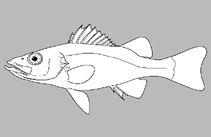
Klassifizierung / Names
Namen | Synonyme | Catalog of Fishes(Gattung, Arten) | ITIS | CoL | WoRMS | Cloffa
Umwelt: Milieu / Klimazone / Tiefenbereich / Verbreitungsgebiet
Ökologie
; süßwasser benthopelagisch. Temperate; 10°C - 30°C (Ref. 2060)
Oceania: Endemic to the Vlaminghian region of south-western Australia.
Länge bei der ersten Reifung / Größe / Gewicht / Alter
Geschlechtsreife: Lm 4.3 range ? - ? cm
Max length : 8.0 cm TL Männchen/unbestimmt; (Ref. 6398); max. veröff. Alter: 5 Jahre (Ref. 44894)
Inhabit almost any permanent fresh water, including flowing or still water of rivers, creeks, wetlands and lakes. Usually found around aquatic vegetation along the margins of streams or lakes. Water is fresh to slightly brackish and clear or tannin-stained (Ref. 44894). Occur at a temperature range of 11.0-26.0 °C (Ref. 1811). Benthic feeder, consuming a variety of microcrustaceans, insects and their larvae. Adults move into small side creeks and flooded streamsides to spawn between July and November. Peak spawning activity is in September and October. Reproductive biology and habits are typical of the family. Maturity is attained at the end of the first year, and maximum life expectancy is about 5 years (Ref. 44894).
Adults spawn between July and January.
Morgan, D.L., S.J. Beatty and M. Adams, 2013. Nannoperca pygmaea, a new species of pygmy perch (Teleostei: Percichthyidae). Zootaxa 3637(4):401-411. (Ref. 93277)
IUCN Rote Liste Status (Ref. 130435: Version 2025-2 (Global))
Bedrohung für Menschen
Harmless
Nutzung durch Menschen
Tools
Zusatzinformationen
Download XML
Internet Quellen
Schätzungen auf der Grundlage von Modellen
Phylogenetischer Diversitätsindex (Ref.
82804): PD
50 = 0.5156 [Uniqueness, from 0.5 = low to 2.0 = high].
Bayesian length-weight: a=0.01047 (0.00397 - 0.02763), b=3.01 (2.78 - 3.24), in cm total length, based on LWR estimates for this (Sub)family-body shape (Ref.
93245).
Trophische Ebene (Ref.
69278): 3.3 ±0.44 se; based on food items.
Widerstandsfähigkeit (Ref.
120179): mittel, Verdopplung der Population dauert 1,4 - 4,4 Jahre. (tmax=5; tm=1; K=1.12; Fec=89).
Anfälligkeit der Fischerei (Ref.
59153): Low vulnerability (12 of 100).
🛈