>
Cichliformes (Cichlids, convict blennies) >
Cichlidae (Cichlids) > Pseudocrenilabrinae
Etymology: Lamprologus: Greek, lampros = light + Greek, lagos = hare (Ref. 45335).
Entorno: milieu / zona climática / rango de profundidad / gama de distribución
Ecología
; agua dulce bentopelágico; pH range: 7.4 - 8.4; dH range: 7 - 30; rango de profundidad 3 - 60 m, usually 5 - 40 m (Ref. 52467). Tropical; 23°C - 27°C (Ref. 12468)
Africa: endemic to Lake Tanganyika, currently only known from the southwestern part of the lake in the Democratic Republic of the Congo (Ref. 46829, 93961).
Tamaño / Peso / Edad
Madurez: Lm ? range ? - ? cm
Max length : 5.0 cm TL macho / no sexado; (Ref. 12468)
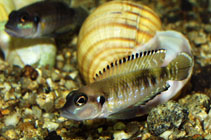
Shell-brooding cichlid found in low-density shell areas; greedy eater, feeding mainly on insect larvae (Ref. 46829). Lives on sandy bottom with snail shells wich are burried in the sand and used as shelter and for depositing the eggs (Ref. 52467). Found between 5 m and 40 m deep (Ref. 93961).
Ciclo vital y comportamiento de apareamiento
Madurez | Reproducción | Puesta | Huevos | Fecundidad | Larva
Eggs are deposited in the snail shell that is inhabited by the female. The female guards and ventilates the eggs. Larve emerge after about 10 days and wander between the shells of their parents (Ref. 52467).
Konings, A., 1998. Tanganyika cichlids in their natural habitat. Cichlid Press. 272 p. (Ref. 46829)
Situación en la Lista Roja de la UICN (Ref. 130435: Version 2025-2 (Global))
Amenaza para el ser humano
Harmless
Usos humanos
Pesquerías: sin interés; Acuario: Comercial
Herramientas
Informes especiales
Descargar XML
Fuentes de Internet
Estimaciones basadas en modelos
Índice de diversidad filogenética (Referencia
82804): PD
50 = 0.5000 [Uniqueness, from 0.5 = low to 2.0 = high].
Bayesian length-weight: a=0.01445 (0.00671 - 0.03113), b=2.99 (2.82 - 3.16), in cm total length, based on LWR estimates for this (Sub)family-body shape (Ref.
93245).
Nivel trófico (Referencia
69278): 3.5 ±0.5 se; based on size and trophs of closest relatives
Resiliencia (Referencia
120179): Alto, población duplicada en un tiempo mínimo inferior a 15 meses (tm<1).
Vulnerabilidad pesquera (Ref.
59153): Low vulnerability (10 of 100).
🛈