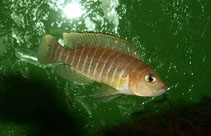
>
Cichliformes (Cichlids, convict blennies) >
Cichlidae (Cichlids) > Pseudocrenilabrinae
Etymology: Neolamprologus: Greek, neos = new + Greek,lampros = torch + Greek, lagos = hare (Ref. 45335).
Umwelt: Milieu / Klimazone / Tiefenbereich / Verbreitungsgebiet
Ökologie
; süßwasser benthopelagisch; pH range: 7.4 - 8.4; dH range: 7 - 30. Tropical; 23°C - 28°C (Ref. 12468)
Africa: endemic to Lake Tanganyika, occurs in the southern part of the lake in the Democratic Republic of the Congo (Ref. 46829, 93981) and in Tanzania (Ref. 46829).
Größe / Gewicht / Alter
Geschlechtsreife: Lm ? range ? - ? cm
Max length : 5.0 cm TL Männchen/unbestimmt; (Ref. 46829); 3.5 cm TL (female)
Associated with large shell beds; also found among rubble of rocky habitats but only at deeper levels (deeper than 25 m); around shell beds species can be found as shallow as 10 metres (Ref. 46829). Maximal depth is 45 metres (Ref. 93981). Prefers shells to holes created by piling up pebbles and small stones; almost always found in colonies; spawning takes place inside the femal's shell (Ref. 46829). Copepods, ostracods, insect larvae, algal strands and sand grain found in stomach (Ref. 93981).
Lebenszyklus und Paarungsverhalten
Geschlechtsreife | Fortpflanzung | Ablaichen | Eier | Fruchtbarkeit | Larven
Konings, A., 1998. Tanganyika cichlids in their natural habitat. Cichlid Press. 272 p. (Ref. 46829)
IUCN Rote Liste Status (Ref. 130435: Version 2025-2 (Global))
Bedrohung für Menschen
Harmless
Nutzung durch Menschen
Fischereien: nicht kommerziell
Tools
Zusatzinformationen
Download XML
Internet Quellen
Schätzungen auf der Grundlage von Modellen
Phylogenetischer Diversitätsindex (Ref.
82804): PD
50 = 0.5000 [Uniqueness, from 0.5 = low to 2.0 = high].
Bayesian length-weight: a=0.00389 (0.00180 - 0.00842), b=3.12 (2.94 - 3.30), in cm total length, based on all LWR estimates for this body shape (Ref.
93245).
Trophische Ebene (Ref.
69278): 3.3 ±0.5 se; based on size and trophs of closest relatives
Widerstandsfähigkeit (Ref.
120179): hoch, Verdopplung der Population dauert weniger als 15 Monate. (Preliminary K or Fecundity.).
Anfälligkeit der Fischerei (Ref.
59153): Low vulnerability (10 of 100).
🛈