Περιβάλλον: περιβάλλον / κλιματική ζώνη / εύρος βάθους / εύρος διανομής
Οικολογία
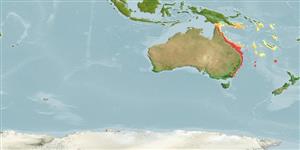
Θαλασσινό(ά); Υφάλμυρο βενθικό(ς); μη μεταναστευτικό(ά); εύρος βάθους 0 - 46 m (Ref. 6335), usually 20 - 22 m. Tropical; 9°S - 45°S, 142°E - 170°E (Ref. 6205)
Western Pacific: east coast of Australia from Cape York (rare) and the Great Barrier Reef, Queensland to eastern Victoria, Ulverstone on northeast coast of Tasmania; Lord Howe Island, New Caledonia, Woodlark Islands, and Papua New Guinea. Bleeker's records (Ref. 1502, 1843) from Batavia and Java were in error (Ref. 4899).
Μήκος κατά την πρώτη ωρίμανση / Μέγεθος / Βάρος / Ηλικία
Γεννητική Ωρίμανση: Lm 24.0 range ? - ? cm
Max length : 51.0 cm TL αρσενικό/απροσδιόριστο; (Ref. 6205); μεγ. δημοσιευμένο βάρος: 1.4 kg (Ref. 6390); μεγ. αναφερόμενη ηλικία: 22 έτη (Ref. 1254)
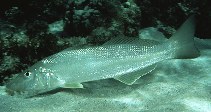
Ραχιαίες άκανθες (συνολικά) : 12; Μαλακές ραχιαίες ακτίνες (συνολικά) : 16 - 18; Εδρικές άκανθες: 2; Μαλακές εδρικές ακτίνες: 15 - 17; Σπόνδυλοι: 32 - 34. The shape of the swim bladder is not distinguishable from that of S. analis. Anterior part of the swim bladder with rudimentary tubules projecting anteriorly and a series laterally that diminish in size and become sawtooth-like posteriorly. The coloration of adult specimens is uniform, without darker bars or blotches. A dark spot is present at the base of the pectoral fin in younger individuals.
Body shape (shape guide): fusiform / normal; Cross section: circular.
An onshore schooling species occurring on coastal beaches, sandbars, and surf zones as well as open bays, estuaries, coastal lakes (Ref. 6205), and rivers as far as tidal limits (Ref. 6390). Keep away from shore when older. Live almost exclusively on sandy ground. Juveniles and adolescents are abundant in shallow waters of rivers and creeks, over seagrass beds and in mangroves (Ref. 6223), although they tend to move into deeper water as they grow older (Ref. 6390). Larvae are present in river mouths and mangrove areas most of the year (Ref. 27634). Oviparous (Ref. 205). Feed mostly on polychaetes and crustaceans. Also caught using tunnel nets (Ref. 6205).
Sand whiting probably spawn twice each season (Ref. 1254, 27633). Spawning occurs at peak high tide, at night, and 1-2 days before the new moon (Ref. 6390).
McKay, R.J., 1992. FAO Species Catalogue. Vol. 14. Sillaginid fishes of the world (family Sillaginidae). An annotated and illustrated catalogue of the sillago, smelt or Indo-Pacific whiting species known to date. Rome: FAO. FAO Fish. Synop. 125(14):87p. (Ref. 6205)
Κατάσταση Κόκκινου Καταλόγου IUCN (Ref. 130435: Version 2025-2 (Global))
Απειλή για τον άνθρωπο
Harmless
Ανθρώπινες χρήσεις
αλιεία: πολύ εμπορικό; Υδατοκαλλιέργειες: πειραματικό; αλιεία αναψυχής: ναί; Ενυδρείο: Δημόσια ενυδρεία
Εργαλεία
Ειδικές εκθέσεις
Λήψη XML
Διαδικτυακές πηγές
Εκτιμήσεις βάσει μοντέλων
Προτιμώμενη θερμοκρασία (Αναφ.
123201): 21.2 - 27.4, mean 25.4 °C (based on 182 cells).
Δείκτης φυλογενετικής ποικιλότητας (Αναφ.
82804): PD
50 = 0.5000 [Uniqueness, from 0.5 = low to 2.0 = high].
Bayesian length-weight: a=0.00617 (0.00344 - 0.01104), b=3.13 (2.97 - 3.29), in cm total length, based on LWR estimates for this species & (Sub)family-body (Ref.
93245).
Τροφικό Επίπεδο (Αναφ.
69278): 3.2 ±0.2 se; based on diet studies.
Ελαστικότητα (Αναφ.
120179): Μεσαίο(α), ελάχιστος χρόνος για διπλασιασμό πληθυσμού 1,4 - 4,4 έτη (K=0.39; tm=2-3; tmax=22; Fec=31,000).
Ευπάθεια στην αλιεία (Ref.
59153): Low to moderate vulnerability (28 of 100).
🛈
Θρεπτικά συστατικά (Ref.
124155): Calcium = 348 [82, 932] mg/100g; Iron = 1.22 [0.47, 3.13] mg/100g; Protein = 20.8 [18.0, 23.0] %; Omega3 = 0.221 [0.099, 0.482] g/100g; Selenium = 43.2 [14.8, 143.3] μg/100g; VitaminA = 27.7 [5.9, 122.3] μg/100g; Zinc = 1.25 [0.65, 3.06] mg/100g (wet weight);