Milieu: milieu / Klimaatzone / Diepte / verspreidingsgebied
Ecologie
marien rifbewoner; diepte 4 - 110 m (Ref. 13227), usually 4 - 20 m (Ref. 13227). Temperate
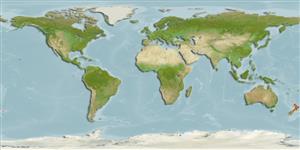
Southwest Pacific: New Zealand.
Grootte / Gewicht / Leeftijd
Maturiteit: Lm ? range ? - ? cm
Max length : 5.0 cm SL mannelijk / geslacht onbekend; (Ref. 13227)
Korte beschrijving
Determinatiesleutels | Morfologie | Morfometrie
Dorsale stekels (totaal) : 23 - 27; Dorsale zachte stralen (totaal) : 12 - 15; Anale stekels: 2; Anale zachte stralen: 25 - 30; Wervels: 39 - 46. Short denticles present on inter-radial circuli. Pterygiophore supporting first segmented ray of third dorsal fin anterior to neural spine of 25th vertebra. Dorsal fin formula V-0N-0-1-0-
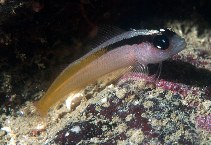
1. Nine procurrent rays in upper caudal lobe, 8 in lower lobe; in upper lobe 1 ray between upper lobe and posterior epural, 5 rays opposite epurals, 3 rays anterior to anterior epural; in lower lobe, 1 ray between lower lobe and haemal spine of second preural vertebra, 6 rays opposite haemal spine of third preural vertebra, 1 ray anterior to haemal spine of third preural vertebra. Front of body white with black eyes, black stripe extending to below base of second dorsal fin, rear part of body white or yellow; body yellow with black head in breeding males, females and non-breeding males white anteriorly, white or yellow posteriorly, with black stripe along lateral line, only reaching to mid-body (Ref. 84085).
Facultative air-breathing in the genus (Ref. 126274); Adults usually inhabit rocky reefs (Ref. 84085). They are found on the sides or under overhangs of large boulders, sheltering in the massive sponge growths or in large, deep crevices. They feed mainly on amphipods, and also on barnacle cyprids and polychaete larvae. Males maybe territorial during the breeding season (Ref. 13227). Eggs are hemispherical and covered with numerous sticky threads that anchor them in the algae on the nesting sites (Ref. 240). Larvae are planktonic which occur primarily in shallow, nearshore waters (Ref. 94114).
Levenscyclus en paargedrag
Maturiteit | Voortplanting | Paaien | Eieren | Fecunditeit | Larven
Fricke, R., 1994. Tripterygiid fishes of Australia, New Zealand and the southwest Pacific Ocean (Teleostei). Theses Zool. 24:1-585. (Ref. 13227)
Status op de Rode Lijst van het IUCN (Ref. 130435: Version 2025-2 (Global))
Gevaar voor de mens
Harmless
Gebruik door de mens
Visserij: van geen belang
Tools
Speciale rapporten
Download XML
Internetbronnen
Schattingen op basis van modellen
Gewenste temperatuur (Ref.
123201): 13.5 - 22.4, mean 18.4 °C (based on 24 cells).
Fylogenetische diversiteitsindex (Ref.
82804): PD
50 = 0.5039 [Uniqueness, from 0.5 = low to 2.0 = high].
Bayesian length-weight: a=0.00617 (0.00290 - 0.01310), b=3.04 (2.86 - 3.22), in cm total length, based on LWR estimates for this (Sub)family-body shape (Ref.
93245).
Trofisch niveau (Ref.
69278): 3.3 ±0.44 se; based on food items.
Weerstandsvermogen (Ref.
120179): Hoog, minimale populatieverdubbelingstijd minder dan 15 maanden (Preliminary K or Fecundity.).
Kwetsbaarheid van de visserij (Ref.
59153): Low vulnerability (10 of 100).
🛈
Voedingsstoffen (Ref.
124155): Calcium = 97.8 [37.9, 286.6] mg/100g; Iron = 0.57 [0.21, 1.26] mg/100g; Protein = 18.4 [16.8, 20.0] %; Omega3 = 0.314 [0.101, 0.983] g/100g; Selenium = 13.5 [3.7, 47.1] μg/100g; VitaminA = 41.2 [6.0, 250.7] μg/100g; Zinc = 1.76 [0.89, 3.24] mg/100g (wet weight);