Klassifizierung / Names
Namen | Synonyme | Catalog of Fishes(Gattung, Arten) | ITIS | CoL | WoRMS | Cloffa
>
Cichliformes (Cichlids, convict blennies) >
Cichlidae (Cichlids) > Geophaginae
Etymology: Geophagus: Greek, gea = the earth + Greek, phagein = to eat (Ref. 45335).
More on authors: Kullander & Taphorn.
Umwelt: Milieu / Klimazone / Tiefenbereich / Verbreitungsgebiet
Ökologie
; süßwasser benthopelagisch; pH range: 5.2 - 7.0. Tropical; 25°C - 30°C (Ref. 13614)
South America: Orinoco River basin, in the upper Caura and lower Caroní River basins.
Größe / Gewicht / Alter
Geschlechtsreife: Lm ? range ? - ? cm
Max length : 10.3 cm SL Männchen/unbestimmt; (Ref. 36377)
Kurzbeschreibung
Bestimmungsschlüssel | Morphologie | Morphometrie
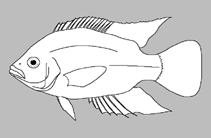
Can be distinguished from all other species in the genus by lacking scaly sheath along the dorsal fin base, and from all except Geophagus taeniopareius by retaining a prominent dark stripe from the eye to the corner of the preopercle as adult. Differs from G. Taeniopareius by (1) distinct light spots on the middle and upper part of the caudal fin, (2) lack of horizontal stripes along the sides, (3) wider lips, (4) lack of microbranchiospines and (5) lower meristics: modally D. XV1.11 instead of XVII. 11 , E1 row scales 30 instead of 32, and vertebrae 14+17 instead of 14+18 (Ref. 57764).
Lebenszyklus und Paarungsverhalten
Geschlechtsreife | Fortpflanzung | Ablaichen | Eier | Fruchtbarkeit | Larven
Kullander, S.O., R. Royero and D.C. Taphorn, 1992. Two new species of Geophagus (Teleostei: Cichlidae) from the Rio Orinoco drainage in Venezuela. Ichthyol. Explor. Freshwat. 3(4):359-375. (Ref. 57764)
IUCN Rote Liste Status (Ref. 130435: Version 2025-2 (Global))
Bedrohung für Menschen
Harmless
Nutzung durch Menschen
Tools
Zusatzinformationen
Download XML
Internet Quellen
Schätzungen auf der Grundlage von Modellen
Phylogenetischer Diversitätsindex (Ref.
82804): PD
50 = 0.5000 [Uniqueness, from 0.5 = low to 2.0 = high].
Bayesian length-weight: a=0.02399 (0.01144 - 0.05029), b=3.01 (2.83 - 3.19), in cm total length, based on LWR estimates for this (Sub)family-body shape (Ref.
93245).
Trophische Ebene (Ref.
69278): 2.5 ±0.1 se; based on size and trophs of closest relatives
Widerstandsfähigkeit (Ref.
120179): hoch, Verdopplung der Population dauert weniger als 15 Monate. (Preliminary K or Fecundity.).
Anfälligkeit der Fischerei (Ref.
59153): Low vulnerability (10 of 100).
🛈