>
Beloniformes (Needle fishes) >
Belonidae (Needlefishes)
Etymology: Belone: Greek, belone = needle; any fish with sharp pointed snout; also Pierre Belon, 1517-64, French zoologist born in Le Mans. Professor at the College de France, author of " La nature et diversité des poissons", 1551 (Ref. 45335).
Eponymy: Dr Pierre Belon (du Mans) (1517–1564) (pen name Petrus Bellonius Cenomanus) was a French diplomat, writer, traveller and naturalist who was deeply interested in antiquity and extolled the virtues of the Renaissance. [...] (Ref. 128868), visit book page.
More on author: Linnaeus.
Taxonomic Remarks
According to authors cited by Evenhuis (1997: Ref. 115711: 480-482), the date of publication of the species should be 1760.
Environnement : milieu / zone climatique / profondeur / gamme de distribution
Écologie
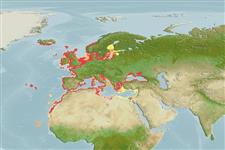
marin; saumâtre pelagic-oceanic; océanodrome (Ref. 51243); profondeur 2 - 22 m (Ref. 130220). Temperate; 65°N - 14°N, 32°W - 42°E
Eastern Atlantic and Mediterranean Sea. Three subspecies were recognized by Collette and Parin (1970, Ref. 34977) Belone belone belone (Linnaeus, 1761) (Northeast Atlantic); Belone belone euxini Günther, 1866 (Black Sea and Sea of Azov); Belone belone acus Risso, 1827 (Mediterranean Sea and adjacent parts of Atlantic Ocean, Madeira, Canary Islands, Azores, and south to Cape Verde (Ref. 50279); subspecies Belone belone gracilis Lowe, 1839 (France to the Canary Islands including the Mediterranean) in Collette & Parin, 1990 (Ref. 5757).
Longueur à la première maturité / Taille / Poids / Âge
Maturité: Lm ? range ? - ? cm
Max length : 104 cm TL mâle / non sexé; (Ref. 123983); common length : 45.0 cm SL mâle / non sexé; (Ref. 3397); poids max. publié: 1.4 kg (Ref. 113079)
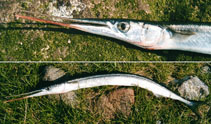
Épines dorsales (Total) : 0; Rayons mous dorsaux (Total) : 16 - 20; Rayons mous anaux: 19 - 23. Jaw teeth comparatively large and widely spaced. Vertebrae 75-84. Vomerine teeth present at lengths greater than 20 cam. Lower jaw a little longer than upper jaw. Juveniles with greatly elongated jaw, without black posterior dorsal fin lobe.
Body shape (shape guide): elongated; Cross section: circular.
Lives close to the surface and has a migratory pattern similar to the mackerel (Ref. 35388). Feeds on small fishes, particularly clupeids and Engraulis (in the Black Sea). Leaps out of the water when hooked. Oviparous (Ref. 205). Eggs may be found attached to objects in the water by tendrils on the egg's surface (Ref. 205). Utilized fresh and frozen; can be fried, broiled and baked (Ref. 9988). Minimum depth reported taken from Ref. 130219.
Collette, B.B. and N.V. Parin, 1986. Belonidae. p. 604-609. In P.J.P. Whitehead, M.-L. Bauchot, J.-C. Hureau, J. Nielsen and E. Tortonese (eds.) Fishes of the north-eastern Atlantic and the Mediterranean, Volume 2. Unesco, Paris. (Ref. 5505)
Statut dans la liste rouge de l'IUCN (Ref. 130435: Version 2025-2 (Global))
Menace pour l'homme
Harmless
Utilisations par l'homme
Pêcheries: commercial; pêche sportive: oui
Outils
Articles particuliers
Télécharger en XML
Sources Internet
Estimations basées sur des modèles
Température préférée (Réf.
123201): 8.8 - 20, mean 11.3 °C (based on 548 cells).
Indice de diversité phylogénétique (Réf.
82804): PD
50 = 0.6250 [Uniqueness, from 0.5 = low to 2.0 = high].
Bayesian length-weight: a=0.00102 (0.00084 - 0.00125), b=3.09 (3.03 - 3.15), in cm total length, based on LWR estimates for this species (Ref.
93245).
Niveau trophique (Réf.
69278): 4.2 ±0.4 se; based on diet studies.
Résilience (Réf.
120179): Milieu, temps minimum de doublement de population : 1,4 à 4,4 années (tm=2; Fec=1000).
Prior r = 0.43, 95% CL = 0.28 - 0.64, Based on 6 data-limited stock assessments.
Vulnérabilité de la pêche (Ref.
59153): Moderate to high vulnerability (49 of 100).
🛈
Vulnérabilité climatique (Ref.
125649): High vulnerability (58 of 100).
🛈
Nutriments (Ref.
124155): Calcium = 50.7 [17.3, 178.7] mg/100g; Iron = 0.407 [0.148, 0.981] mg/100g; Protein = 17.8 [15.7, 20.3] %; Omega3 = 0.702 [0.293, 1.650] g/100g; Selenium = 9.33 [3.62, 22.32] μg/100g; VitaminA = 18.6 [5.4, 78.0] μg/100g; Zinc = 0.482 [0.202, 0.927] mg/100g (wet weight); based on
nutrient studies.