>
Blenniiformes (Blennies) >
Tripterygiidae (Triplefin blennies) > Tripterygiinae
Etymology: Enneapterygius: Greek, ennea = nine times + Greek, pterygion = little fin (Ref. 45335).
More on author: Fricke.
Entorno: milieu / zona climática / rango de profundidad / gama de distribución
Ecología
marino demersal; rango de profundidad 1 - 8 m (Ref. 13227). Tropical
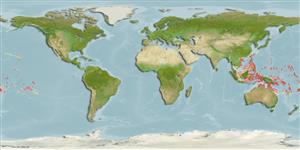
Western Central Pacific.
Tamaño / Peso / Edad
Madurez: Lm ? range ? - ? cm
Max length : 2.7 cm SL macho / no sexado; (Ref. 13227)
Descripción breve
Claves de identificación | Morfología | Morfometría
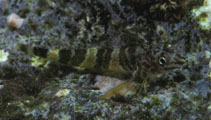
Espinas dorsales (total) : 14 - 18; Radios blandos dorsales (total) : 7 - 11; Espinas anales: 1; Radios blandos anales: 15 - 20. Male blackish on fins and anterior three-fourths of body , and yellow caudal-fin with median black band. Female yellowish with 3 broad, greyish double bars divided by thin grey line, broad black bar at base of caudal-fin, and greyish head with brown markings. Head, chest, and pectoral-fin base scaleless; long and slender orbital tentacle; mandibular pores 3-4 + 3-4 + 3-4. Maximum size to 3.2 cm TL (Ref. 90102).
Body shape (shape guide): elongated; Cross section: oval.
Adults are found in coral and rocky reefs (Ref. 90102). Eggs are hemispherical and covered with numerous sticky threads that anchor them in the algae on the nesting sites (Ref. 240). Larvae are planktonic which occur primarily in shallow, nearshore waters (Ref. 94114). Feeds on small benthic invertebrates (Ref. 89972).
Ciclo vital y comportamiento de apareamiento
Madurez | Reproducción | Puesta | Huevos | Fecundidad | Larva
Fricke, R., 1994. Tripterygiid fishes of Australia, New Zealand and the southwest Pacific Ocean (Teleostei). Theses Zool. 24:1-585. (Ref. 13227)
Situación en la Lista Roja de la UICN (Ref. 130435: Version 2025-2 (Global))
Amenaza para el ser humano
Harmless
Usos humanos
Pesquerías: sin interés
Herramientas
Informes especiales
Descargar XML
Fuentes de Internet
Estimaciones basadas en modelos
Temperatura preferida (Referencia
123201): 26 - 29.3, mean 28.6 °C (based on 1580 cells).
Índice de diversidad filogenética (Referencia
82804): PD
50 = 0.5000 [Uniqueness, from 0.5 = low to 2.0 = high].
Bayesian length-weight: a=0.00617 (0.00290 - 0.01310), b=3.04 (2.86 - 3.22), in cm total length, based on LWR estimates for this (Sub)family-body shape (Ref.
93245).
Nivel trófico (Referencia
69278): 3.1 ±0.3 se; based on size and trophs of closest relatives
Resiliencia (Referencia
120179): Alto, población duplicada en un tiempo mínimo inferior a 15 meses (Preliminary K or Fecundity.).
Vulnerabilidad pesquera (Ref.
59153): Low vulnerability (10 of 100).
🛈