>
Blenniiformes (Blennies) >
Tripterygiidae (Triplefin blennies) > Tripterygiinae
Etymology: Enneapterygius: Greek, ennea = nine times + Greek, pterygion = little fin (Ref. 45335).
More on author: Fricke.
Entorno: milieu / zona climática / rango de profundidad / gama de distribución
Ecología
marino asociado a arrecife; rango de profundidad 2 - 4 m (Ref. 13227). Tropical
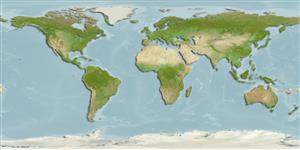
Western Central Pacific: known only from the Baie de St. Vincent, New Caledonia.
Tamaño / Peso / Edad
Madurez: Lm ? range ? - ? cm
Max length : 3.3 cm SL macho / no sexado; (Ref. 54980)
Descripción breve
Claves de identificación | Morfología | Morfometría
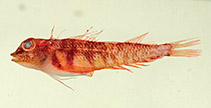
Espinas dorsales (total) : 16; Radios blandos dorsales (total) : 8 - 9; Espinas anales: 1; Radios blandos anales: 20. Short supraorbital tentacle; first dorsal-fin 25% shorter than second dorsal fin; male coloration whitish with fine specks of black dots, darkening on area of opercle; rough reticular pattern of deep reddish brown on body; base of pectoral fin bearing a broad, dark reddish brown bar; anal fin and first 2 dorsal fins dusky colored with weak red rays; transparent caudal fin bearing a reddish white bar at its base, proximal end with vertically aligned reddish dots. Dorsal rays III + XIII + 8-9; lateral line interrupted, 17-18 + 20-21; mandibular pores 5 + 2 + 5 (Ref. 54980).
Body shape (shape guide): elongated.
Eggs are hemispherical and covered with numerous sticky threads that anchor them in the algae on the nesting sites (Ref. 240). Larvae are planktonic which occur primarily in shallow, nearshore waters (Ref. 94114).
Ciclo vital y comportamiento de apareamiento
Madurez | Reproducción | Puesta | Huevos | Fecundidad | Larva
Fricke, R., 1994. Tripterygiid fishes of Australia, New Zealand and the southwest Pacific Ocean (Teleostei). Theses Zool. 24:1-585. (Ref. 13227)
Situación en la Lista Roja de la UICN (Ref. 130435: Version 2025-2 (Global))
Amenaza para el ser humano
Harmless
Usos humanos
Pesquerías: sin interés
Herramientas
Informes especiales
Descargar XML
Fuentes de Internet
Estimaciones basadas en modelos
Temperatura preferida (Referencia
123201): 24.7 - 28, mean 26.4 °C (based on 225 cells).
Índice de diversidad filogenética (Referencia
82804): PD
50 = 0.5000 [Uniqueness, from 0.5 = low to 2.0 = high].
Bayesian length-weight: a=0.00617 (0.00290 - 0.01310), b=3.04 (2.86 - 3.22), in cm total length, based on LWR estimates for this (Sub)family-body shape (Ref.
93245).
Nivel trófico (Referencia
69278): 3.1 ±0.3 se; based on size and trophs of closest relatives
Resiliencia (Referencia
120179): Alto, población duplicada en un tiempo mínimo inferior a 15 meses (Preliminary K or Fecundity.).
Vulnerabilidad pesquera (Ref.
59153): Low vulnerability (10 of 100).
🛈