Umwelt: Milieu / Klimazone / Tiefenbereich / Verbreitungsgebiet
Ökologie
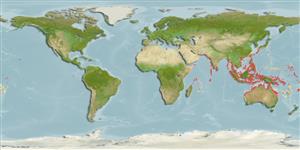
seewasser; süßwasser; brackwasser demersal; amphidrom (Ref. 126106); tiefenbereich 0 - 5 m (Ref. 90102). Tropical; 20°C - 28°C (Ref. 13371); 35°N - 33°S, 48°E - 171°W
Indo-Pacific: Kuwait to Fiji, north to southern Japan, south to New Caledonia. Reported from Samoa (Ref. 9710), Tonga (Ref. 53797), and the Society Islands (Ref. 2847).
Länge bei der ersten Reifung / Größe / Gewicht / Alter
Geschlechtsreife: Lm ?, range 14 - ? cm
Max length : 45.0 cm TL Männchen/unbestimmt; (Ref. 108711); common length : 20.0 cm TL Männchen/unbestimmt; (Ref. 3489)
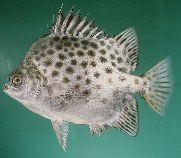
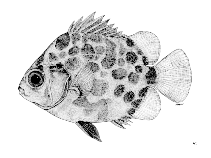
Rückenflossenstacheln (insgesamt) : 10 - 11; Rückenflossenweichstrahlen (insgesamt) : 16 - 18; Afterflossenstacheln: 4; Afterflossenweichstrahlen: 13 - 15. Ground colour greenish. Juveniles with a few large roundish blotches, about size of eye, or with about 5 or 6 broad, dark, vertical bars. In large adults, spots may be faint and restricted to dorsal part of flanks. Body quadrangular, strongly compressed. Dorsal head profile steep. Eye moderately large, its diameter somewhat smaller than snout length. Snout rounded. Mouth small, horizontal, not protractile. Teeth villiform, in several rows on jaws (ref 43044).
Body shape (shape guide): short and / or deep.
Adults inhabit harbors, natural embayments, brackish estuaries and the lower reaches of freshwater streams, frequently occurring among mangroves. They feed on worms, crustaceans, insects and plant matter (Ref. 7020, 44894, 48637). The dorsal, anal and pelvic spines are believed by Philippine fishers to be venomous and capable of inflicting wounds (Ref. 6565). Used in Chinese medicine (Ref. 12166). In Hong Kong live fish markets (Ref. 27253). Marketed as fresh (Ref. 12693).
Multiple spawner (Ref. 102820).
Allen, G.R., 1984. Scatophagidae. In W. Fischer and G. Bianchi (eds.) FAO species identification sheets for fishery purposes. Western Indian Ocean (Fishing Area 51). volume 4. [var. pag.]. FAO, Rome. (Ref. 3489)
IUCN Rote Liste Status (Ref. 130435: Version 2025-2 (Global))
Nutzung durch Menschen
Fischereien: weniger kommerziell; Aquakultur: kommerziell; Aquarium: Kommerziell
Tools
Zusatzinformationen
Download XML
Internet Quellen
Schätzungen auf der Grundlage von Modellen
Bevorzugte Temperatur (Ref.
123201): 25.4 - 29.3, mean 28.6 °C (based on 2701 cells).
Phylogenetischer Diversitätsindex (Ref.
82804): PD
50 = 0.8125 [Uniqueness, from 0.5 = low to 2.0 = high].
Bayesian length-weight: a=0.03236 (0.02363 - 0.04432), b=2.92 (2.83 - 3.01), in cm total length, based on LWR estimates for this species (Ref.
93245).
Trophische Ebene (Ref.
69278): 3.0 ±0.35 se; based on food items.
Generation time: 0.9 ( na - na) years. Estimated as median ln(3)/K based on 1
growth studies.
Widerstandsfähigkeit (Ref.
120179): hoch, Verdopplung der Population dauert weniger als 15 Monate. (K=0.97; tm=1; Fec=486,500).
Anfälligkeit der Fischerei (Ref.
59153): Low vulnerability (20 of 100).
🛈
Nährstoffe (Ref.
124155): Calcium = 80.7 [40.4, 127.3] mg/100g; Iron = 0.8 [0.5, 1.4] mg/100g; Protein = 19.2 [18.0, 20.3] %; Omega3 = 0.0919 [, ] g/100g; Selenium = 28.9 [14.3, 62.6] μg/100g; VitaminA = 22.8 [6.1, 87.4] μg/100g; Zinc = 1.49 [0.96, 2.24] mg/100g (wet weight); based on
nutrient studies.