>
Blenniiformes (Blennies) >
Tripterygiidae (Triplefin blennies) > Tripterygiinae
Etymology: Enneapterygius: Greek, ennea = nine times + Greek, pterygion = little fin (Ref. 45335).
Eponymy: Dr Helen K Larson was Curator of Fishes, Museum and Art Gallery of the Northern Territory, Darwin, Australia (1981–2009), retiring as Emeritus Curator, and is now a Research Associate at the Museum of Tropical Queensland, Townsville. [...] (Ref. 128868), visit book page.
More on author: Fricke.
Environnement : milieu / zone climatique / profondeur / gamme de distribution
Écologie
marin démersal; non migrateur; profondeur 0 - 12 m (Ref. 13227). Tropical
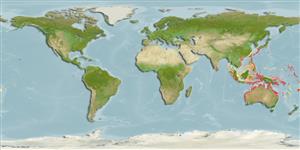
Southwest Pacific: Papua New Guinea and Australia.
Taille / Poids / Âge
Maturité: Lm ? range ? - ? cm
Max length : 3.5 cm SL mâle / non sexé; (Ref. 13227)
Description synthétique
Clés d'identification | Morphologie | Morphométrie
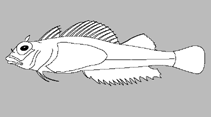
Épines dorsales (Total) : 14 - 17; Rayons mous dorsaux (Total) : 8 - 12; Épines anales: 1; Rayons mous anaux: 14 - 20. Male dusky red with black "mask" covering most of head, chest, and pectoral-fin base, about 5 whitish saddles/bars on back (a few extending on lower side), and white bar on pectoral-fin base (immediately posterior to black area). Female mainly brownish or greenish with white bars. Dorsal rays III + XI-XIV + 8-12; anal rays I,14-20; pectoral rays 14-18; pelvic rays I,2; lateral line interrupted, 14-20 + 13-20; head, chest, and pectoral-fin base scaleless; lobate orbital tentacle; mandibular pores 3-4 + 1-2 +3-4. Maximum size to 4.4 cm TL (Ref. 90102).
Body shape (shape guide): elongated; Cross section: oval.
Adults occur at shallow depths, often seen associated with coralline rocks, seagrass or algae (Ref. 13227). Eggs are hemispherical and covered with numerous sticky threads that anchor them in the algae on the nesting sites (Ref. 240). Larvae are planktonic which occur primarily in shallow, nearshore waters (Ref. 94114).
Cycle de vie et comportement reproducteur
Maturité | Reproduction | Frai | Œufs | Fécondité | Larves
Fricke, R., 1994. Tripterygiid fishes of Australia, New Zealand and the southwest Pacific Ocean (Teleostei). Theses Zool. 24:1-585. (Ref. 13227)
Statut dans la liste rouge de l'IUCN (Ref. 130435: Version 2025-2 (Global))
Menace pour l'homme
Harmless
Utilisations par l'homme
Pêcheries: sans intérêt
Outils
Articles particuliers
Télécharger en XML
Sources Internet
Estimations basées sur des modèles
Température préférée (Réf.
123201): 23.3 - 29.3, mean 27.9 °C (based on 1065 cells).
Indice de diversité phylogénétique (Réf.
82804): PD
50 = 0.5000 [Uniqueness, from 0.5 = low to 2.0 = high].
Bayesian length-weight: a=0.00617 (0.00290 - 0.01310), b=3.04 (2.86 - 3.22), in cm total length, based on LWR estimates for this (Sub)family-body shape (Ref.
93245).
Niveau trophique (Réf.
69278): 3.1 ±0.3 se; based on size and trophs of closest relatives
Résilience (Réf.
120179): Haut, temps minimum de doublement de population inférieur à 15 mois (Preliminary K or Fecundity.).
Vulnérabilité de la pêche (Ref.
59153): Low vulnerability (10 of 100).
🛈
Nutriments (Ref.
124155): Calcium = 1370 [560, 6,275] mg/100g; Iron = 4.37 [1.63, 10.78] mg/100g; Protein = 17.4 [15.7, 19.0] %; Omega3 = 0.157 [0.038, 0.675] g/100g; Selenium = 93 [17, 373] μg/100g; VitaminA = 12 [2, 84] μg/100g; Zinc = 5.75 [2.55, 10.70] mg/100g (wet weight);