>
Cichliformes (Cichlids, convict blennies) >
Cichlidae (Cichlids) > Cichlasomatinae
Etymology: Parachromis: Greek, para = the side of + Greek, chromis = a fish, perhaps a perch (Ref. 45335).
More on author: Günther.
Taxonomic Remarks
Reviewed in Kullander & Hartel, 1997, with redescription and photo, and lectotype designation of P. gulosus. Heros managuensis described in more detail in Günther 1868:463, pl. 77 (fig. 3). Reviewed by Bussing (1998: 367), with key, diagnosis, geographical distribution, and figures.
Môi trường: môi trường / vùng khí hậu / Mức độ sâu / phạm vi phân phối
Sinh thái học
; nước ngọt sống nổi và đáy; pH range: 7.0 - 8.7; dH range: 10 - 15; không di cư (Ref. 126106); mức độ sâu 3 - 10 m (Ref. 80549). Tropical; 25°C - 36°C (Ref. 36880); 37°N - 9°N
Central America: Atlantic slope from the Ulua River (Honduras) to the Matina River (Costa Rica).
Bộ gần gũi / Khối lượng (Trọng lượng) / Tuổi
Chín muồi sinh dục: Lm ? range ? - ? cm
Max length : 55.0 cm TL con đực/không giới tính; (Ref. 40637); Khối lượng cực đại được công bố: 1.6 kg (Ref. 40637)
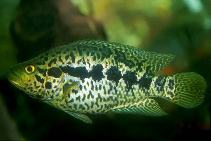
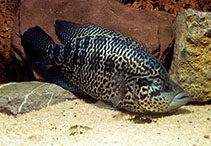
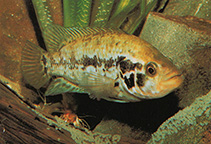
Các tia vây lưng cứng (tổng cộng) : 17 - 18; Các vây lưng mềm (tổng cộng) : 10 - 11; Tia cứng vây hậu môn: 6 - 8; Tia mềm vây hậu môn: 11 - 12. This species is distinguished by its large mouth, projecting lower jaw, prominent enlarged canine teeth, black spots on fins and body, a more or less continuous black stripe between the eye and opercular margin, another between the eye and the lower angle of the opercle; a row of black blotches along the middle of the side. Distinguished from other members of the genus by having the preopercle expanded at the angle. Body color silvery or golden-green to purple; back moss green, sides with purple iridescence, belly whitish or yellowish; dorsal, anal and caudal fins with numerous black spots, interspaces whitish, yellowish or with blue iridescence; a black blotch on the caudal-fin base. Breeding females with stronger crimson hue to the gill cover.
Body shape (shape guide): fusiform / normal; Cross section: oval.
Adults inhabit lakes, preferring turbid waters and mud bottoms of the highly eutrophic lakes (Ref. 7335), in springs and ponds over detritus and sand bottom (Ref. 5723). Commonly found in very warm, oxygen depleted inundation lakes (Ref. 8978). Highly predaceous, feeding mainly on small fishes and macroinvertebrates (Ref. 7335; 44091). Oviparous, they spawn in batches (Ref. Highly esteemed as food fish (Ref. 44091). Maximum length 63 cm TL (Ref. 5723).
Deposits up to 5,000 eggs on rocks and other hard substrates; both parents guard the eggs and resulting fry (Ref. 44091). Reported to deposit up to 10,496 eggs (Ref. 80549).
Kullander, S.O., 2003. Cichlidae (Cichlids). p. 605-654. In R.E. Reis, S.O. Kullander and C.J. Ferraris, Jr. (eds.) Checklist of the Freshwater Fishes of South and Central America. Porto Alegre: EDIPUCRS, Brasil. (Ref. 36377)
Tình trạng Sách đỏ IUCN (Ref. 130435: Version 2025-2 (Global))
Mối đe dọa đối với con người
Potential pest
Sử dụng của con người
Các nghề cá: tính thương mại; Nuôi trồng thủy sản: tính thương mại; cá để chơi: đúng; Bể nuôi cá: Tính thương mại
Các công cụ
Báo cáo đặc biệt
Tải xuống XML
Các nguồn internet
Ước tính dựa trên mô hình
Chỉ số đa dạng phát sinh loài (Tài liệu tham khảo
82804): PD
50 = 0.5312 [Uniqueness, from 0.5 = low to 2.0 = high].
Bayesian length-weight: a=0.02089 (0.01350 - 0.03232), b=3.05 (2.92 - 3.18), in cm total length, based on LWR estimates for this species & (Sub)family-body (Ref.
93245).
Mức dinh dưỡng (Tài liệu tham khảo
69278): 4.0 ±0.59 se; based on food items.
Thích nghi nhanh (Tài liệu tham khảo
120179): Trung bình, thời gian nhân đôi của chủng quần tối thiểu là 1.4 - 4.4 năm (Assuming tm=1-2; Fec=10,000).
Sự dễ bị tổn thương của nghề đánh cá (Ref.
59153): Moderate vulnerability (42 of 100).
🛈