>
Blenniiformes (Blennies) >
Chaenopsidae (Pike-, tube- and flagblennies)
Etymology: Ekemblemaria: Greek, ek = from, out, of, over + Greek, enblema, -atos = insertion (Ref. 45335).
Eponymy: Dr George Sprague Myers (1905–1985), an American ichthyologist, bio-geographer and herpetologist, was Professor Emeritus of Biological Sciences at Stanford, California. [...] (Ref. 128868), visit book page.
Umwelt: Milieu / Klimazone / Tiefenbereich / Verbreitungsgebiet
Ökologie
seewasser demersal; tiefenbereich 1 - 4 m (Ref. 11482). Tropical
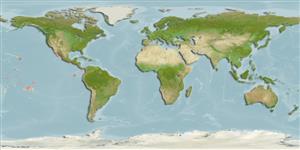
Eastern Central Pacific: Gulf of California to Colombia.
Größe / Gewicht / Alter
Geschlechtsreife: Lm ? range ? - ? cm
Max length : 7.0 cm TL Männchen/unbestimmt; (Ref. 11482)
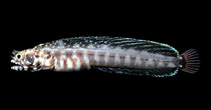
Inhabits mollusk tubes on rocky outcrops in sand-weed areas. Feeds on invertebrates.
Lebenszyklus und Paarungsverhalten
Geschlechtsreife | Fortpflanzung | Ablaichen | Eier | Fruchtbarkeit | Larven
Allen, G.R. and D.R. Robertson, 1994. Fishes of the tropical eastern Pacific. University of Hawaii Press, Honolulu. 332 p. (Ref. 11482)
IUCN Rote Liste Status (Ref. 130435: Version 2025-2 (Global))
Bedrohung für Menschen
Harmless
Nutzung durch Menschen
Tools
Zusatzinformationen
Download XML
Internet Quellen
Schätzungen auf der Grundlage von Modellen
Bevorzugte Temperatur (Ref.
123201): 23.3 - 29.1, mean 27.4 °C (based on 202 cells).
Phylogenetischer Diversitätsindex (Ref.
82804): PD
50 = 0.6250 [Uniqueness, from 0.5 = low to 2.0 = high].
Bayesian length-weight: a=0.00525 (0.00224 - 0.01232), b=3.07 (2.86 - 3.28), in cm total length, based on LWR estimates for this (Sub)family-body shape (Ref.
93245).
Trophische Ebene (Ref.
69278): 3.5 ±0.37 se; based on food items.
Anfälligkeit der Fischerei (Ref.
59153): Low vulnerability (10 of 100).
🛈
Nährstoffe (Ref.
124155): Calcium = 465 [266, 1,044] mg/100g; Iron = 1.49 [0.83, 2.70] mg/100g; Protein = 17.6 [16.6, 18.7] %; Omega3 = 0.146 [0.068, 0.300] g/100g; Selenium = 22.9 [9.6, 55.0] μg/100g; VitaminA = 57 [17, 185] μg/100g; Zinc = 2.29 [1.51, 3.40] mg/100g (wet weight);