>
Beloniformes (Needle fishes) >
Hemiramphidae (Halfbeaks)
Etymology: Rhynchorhamphus: Greek, rhingchos = snout + Greek,rhamphos = bill (Ref. 45335).
Eponymy: Georges Dussumier is described in the etymology as a friend of Valenciennes. [...] (Ref. 128868), visit book page.
More on author: Valenciennes.
Umwelt: Milieu / Klimazone / Tiefenbereich / Verbreitungsgebiet
Ökologie
seewasser; süßwasser; brackwasser pelagic-neritic; tiefenbereich 0 - ? m. Tropical
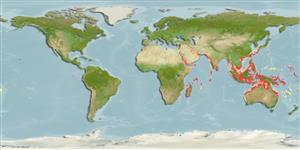
Indo-West Pacific: the most widespread of the four species of Rhynchorhamphus, found from Persian Gulf through Arabian Sea and Bay of Bengal through the Western Central Pacific north to Taiwan and Hong Kong and east to New Guinea and northern Australia.
Länge bei der ersten Reifung / Größe / Gewicht / Alter
Geschlechtsreife: Lm 15.8, range 15 - 16.5 cm
Max length : 31.0 cm Männchen/unbestimmt; (Ref. 10943)
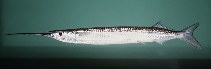
Rückenflossenstacheln (insgesamt) : 0; Rückenflossenweichstrahlen (insgesamt) : 13 - 17; Afterflossenstacheln: 0; Afterflossenweichstrahlen: 13 - 16; Wirbelzahl: 54 - 59. Very strongly pronounced domed upper jaw which is the longest and most arched of the four species of Rhynchorhamphus.
Body shape (shape guide): elongated.
Found in inshore waters (Ref. 75154). Enters freshwaters (Ref 13446).
Lebenszyklus und Paarungsverhalten
Geschlechtsreife | Fortpflanzung | Ablaichen | Eier | Fruchtbarkeit | Larven
Collette, B.B. and J. Su, 1986. The halfbeaks (Pisces, Beloniformes, Hemiramphidae) of the Far East. Proc. Acad. Nat. Sci. Philadelphia 138(1):250-301. (Ref. 10943)
IUCN Rote Liste Status (Ref. 130435: Version 2025-2 (Global))
Bedrohung für Menschen
Harmless
Nutzung durch Menschen
Fischereien: weniger kommerziell
Tools
Zusatzinformationen
Download XML
Internet Quellen
Schätzungen auf der Grundlage von Modellen
Bevorzugte Temperatur (Ref.
123201): 24.9 - 29.2, mean 28.3 °C (based on 1440 cells).
Phylogenetischer Diversitätsindex (Ref.
82804): PD
50 = 0.5625 [Uniqueness, from 0.5 = low to 2.0 = high].
Bayesian length-weight: a=0.00251 (0.00133 - 0.00475), b=2.95 (2.78 - 3.12), in cm total length, based on LWR estimates for this species & (Sub)family-body (Ref.
93245).
Trophische Ebene (Ref.
69278): 3.1 ±0.2 se; based on size and trophs of closest relatives
Generation time: 0.8 ( na - na) years. Estimated as median ln(3)/K based on 1
growth studies.
Widerstandsfähigkeit (Ref.
120179): hoch, Verdopplung der Population dauert weniger als 15 Monate. (K>1).
Anfälligkeit der Fischerei (Ref.
59153): Low vulnerability (16 of 100).
🛈