>
Cyprinodontiformes (Rivulines, killifishes and live bearers) >
Poeciliidae (Poeciliids) > Poeciliinae
Etymology: Limia: Limia derived from the Latin 'limus' meaning mud, pertaining to the feeding habits of the fish, from Poey, 1854. Donald Taphorn, pers. comm. 22 Feb 2015.
More on author: Guichenot.
Environnement : milieu / zone climatique / profondeur / gamme de distribution
Écologie
; eau douce; saumâtre démersal; pH range: 7.5 - 8.2; dH range: 25 - 30; non migrateur (Ref. 126106). Tropical; 18°C - 24°C (Ref. 13371)
Central America: endemic to Cuba.
Taille / Poids / Âge
Maturité: Lm ? range ? - ? cm
Max length : 8.0 cm TL mâle / non sexé; (Ref. 37198); 10.0 cm TL (female)
Description synthétique
Clés d'identification | Morphologie | Morphométrie
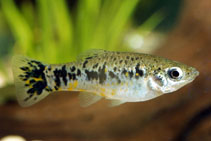
Blue-gray back, silvery sides and a white belly; scales edged with black producing a "fishnet" pattern on the sides; females with a yellow patch near the vent; male's dorsal fin and tail usually yellow-orange with blue black speckles; females with colorless fins and growing to more than double the size of males (Ref. 44091).
Body shape (shape guide): fusiform / normal.
Adults inhabit streams, lakes, estuaries, coastal lagoons and mangrove swamps. They feed on worms, crustaceans, insects and plant matter (Ref. 7020). Often found in the company of sailfin molly and mosquitofish (Ref. 4409).
Cycle de vie et comportement reproducteur
Maturité | Reproduction | Frai | Œufs | Fécondité | Larves
Produces 20-50 young. Large females can produce >100 fry every 4-6 weeks (Ref. 44091).
Lee, D.S., S.P. Platania and G.H. Burgess, 1983. Atlas of North American freshwater fishes, 1983 supplement. Occasional Papers of the North Carolina Biological Survey no. 1983-6. North Carolina State Museum of Natural History, Raleigh, N.C. 67 p. (Ref. 13498)
Statut dans la liste rouge de l'IUCN (Ref. 130435: Version 2025-2 (Global))
Menace pour l'homme
Harmless
Utilisations par l'homme
Pêcheries: sans intérêt; Aquarium: Commercial
Outils
Articles particuliers
Télécharger en XML
Sources Internet
Estimations basées sur des modèles
Indice de diversité phylogénétique (Réf.
82804): PD
50 = 0.5000 [Uniqueness, from 0.5 = low to 2.0 = high].
Bayesian length-weight: a=0.01047 (0.00458 - 0.02392), b=3.14 (2.96 - 3.32), in cm total length, based on LWR estimates for this (Sub)family-body shape (Ref.
93245).
Niveau trophique (Réf.
69278): 2.9 ±0.34 se; based on food items.
Résilience (Réf.
120179): Haut, temps minimum de doublement de population inférieur à 15 mois (tm=0.66).
Vulnérabilité de la pêche (Ref.
59153): Low vulnerability (10 of 100).
🛈