Klassifizierung / Names
Namen | Synonyme | Catalog of Fishes(Gattung, Arten) | ITIS | CoL | WoRMS | Cloffa
>
Cyprinodontiformes (Rivulines, killifishes and live bearers) >
Poeciliidae (Poeciliids) > Poeciliinae
Etymology: Gambusia: Gambusia: From the Cuban term, Gambusino, which means "nothing", usually in the context of a joke or a farce. Fishing for gambusinos = when one catches nothing (Ref. 45335).
More on author: Günther.
Umwelt: Milieu / Klimazone / Tiefenbereich / Verbreitungsgebiet
Ökologie
; süßwasser; brackwasser benthopelagisch. Tropical; 25°C - 26°C (Ref. 36880)
Central America: Guatemala to Panama.
Größe / Gewicht / Alter
Geschlechtsreife: Lm ? range ? - ? cm
Max length : 3.0 cm SL Männchen/unbestimmt; (Ref. 30499); 4.1 cm SL (female)
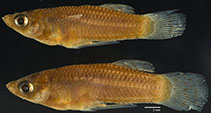
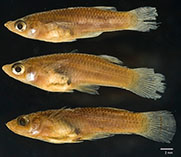
Head and body gray. A triangular black blotch below the eye. Caudal fin with 6 - 7 black spots forming a vertical series in the center of the fin; sometimes there are similar spots on the dorsal fin. Anal fin dusky. Snout pointed. Dorsal fin inserts behind the end of the anal-fin base (Ref. 36880).
Body shape (shape guide): elongated; Cross section: oval.
Collected only on three occasions in the mouth of slow-moving streams, in brackish or fresh waters within a few meters of the sea. Swims in small groups near the surface over sandy or muddy bottoms at temperatures of 25-26°C. Feeds on aquatic insects (Ref. 36880).
Lebenszyklus und Paarungsverhalten
Geschlechtsreife | Fortpflanzung | Ablaichen | Eier | Fruchtbarkeit | Larven
Lucinda, P.H.F., 2003. Poeciliidae (Livebearers). p. 555-581. In R.E. Reis, S.O. Kullander and C.J. Ferraris, Jr. (eds.) Checklist of the Freshwater Fishes of South and Central America. Porto Alegre: EDIPUCRS, Brazil. (Ref. 50894)
IUCN Rote Liste Status (Ref. 130435: Version 2025-2 (Global))
Bedrohung für Menschen
Harmless
Nutzung durch Menschen
Tools
Zusatzinformationen
Download XML
Internet Quellen
Schätzungen auf der Grundlage von Modellen
Phylogenetischer Diversitätsindex (Ref.
82804): PD
50 = 0.5000 [Uniqueness, from 0.5 = low to 2.0 = high].
Bayesian length-weight: a=0.00851 (0.00369 - 0.01962), b=3.15 (2.96 - 3.34), in cm total length, based on LWR estimates for this (Sub)family-body shape (Ref.
93245).
Trophische Ebene (Ref.
69278): 3.2 ±0.40 se; based on food items.
Widerstandsfähigkeit (Ref.
120179): hoch, Verdopplung der Population dauert weniger als 15 Monate. (Preliminary K or Fecundity.).
Anfälligkeit der Fischerei (Ref.
59153): Low vulnerability (10 of 100).
🛈