Teleostei (teleosts) >
Blenniiformes (Blennies) >
Blenniidae (Combtooth blennies) > Blenniinae
Etymology: Meiacanthus: Greek, meion = less = lessen + Greek, akantha = thorn (Ref. 45335); abditus: From the Latin abditus meaning hidden or concealed refers to the previous confusion of this species with M. lineatus.
Environment: milieu / climate zone / depth range / distribution range
Ecology
Marine; demersal; depth range 3 - 40 m (Ref. 90102). Tropical
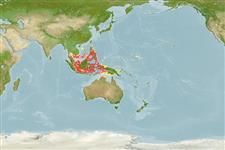
Western Central Pacific: Sulu Archipelago, Philippines.
Size / Weight / Age
Maturity: Lm ? range ? - ? cm
Max length : 11.0 cm TL male/unsexed; (Ref. 90102)
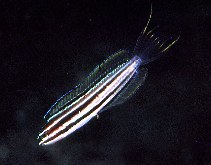
Large adults with multiple filaments on the tail and button-like marking along the mid-lateral stripe (Ref. 48636).
Body shape (shape guide): elongated.
Adults occur in small schools along deep outer reef walls, usually swims upside-down on the ceilings of large caves (Ref. 48636). Oviparous. Eggs are demersal and adhesive (Ref. 205), and are attached to the substrate via a filamentous, adhesive pad or pedestal (Ref. 94114). Larvae are planktonic, often found in shallow, coastal waters (Ref. 94114).
Life cycle and mating behavior
Maturity | Reproduction | Spawning | Eggs | Fecundity | Larvae
Oviparous, distinct pairing (Ref. 205).
Smith-Vaniz, W.F., 1987. The saber-toothed blennies, tribe Nemophini (Pisces: Bleniidae): an update. Proc. Acad. Nat. Sci. Philad. 139:1-52. (Ref. 7401)
IUCN Red List Status (Ref. 130435: Version 2025-2 (Global))
Threat to humans
Harmless
Human uses
Tools
Fatal error: Uncaught mysqli_sql_exception: Too many connections in /var/www/html/includes/speciessummary.lib.php:1888
Stack trace:
#0 /var/www/html/includes/speciessummary.lib.php(1888): mysqli->__construct('mysql', 'fbuser', Object(SensitiveParameterValue), 'fbquizv2', '3306')
#1 /var/www/html/summary/SpeciesSummary.php(1851): checkRecordDisplayFBQuizV2('46573', 'PicList')
#2 {main}
thrown in /var/www/html/includes/speciessummary.lib.php on line 1888