Окружающая среда: среда / климатическая зона / пределы глубины / диапазон распространения
экология
; пресноводный донно-пелагический; pH range: 6.0 - 8.0; dH range: 5 - 19. Tropical; 18°C - 24°C (Ref. 1672); 33°N - 8°N, 66°E - 98°E
Asia: Pakistan, India, Bangladesh, Nepal and Myanmar (Ref. 41236). Reported from Bhutan (Ref. 40882). Appearance in Colombian waters presumably by escape from an aquarium fish rearing facility (Ref. 1739).
Длина при первой зрелости / Размер / Вес / Возраст
половая зрелость: Lm 2.5 range ? - ? cm
Max length : 3.8 cm SL самец/пол неопределен; (Ref. 137577)
Краткое описание
определительные ключи | морфология | морфометрия
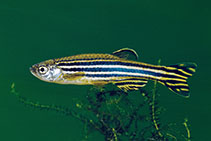
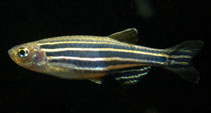
позвонки: 31 - 32. Five uniformly, pigmented, horizontal stripes on the side of the body, all extending onto the end of caudal fin rays. Anal fin distinctively striped. Lateral line absent. Rostral barbels extend to anterior margin of orbit; maxillary barbels end at about middle of opercle. Branched anal fin rays 10-12. Vertebrae 31-32.
Body shape (shape guide): fusiform / normal; Cross section: compressed.
Adults inhabit streams, canals, ditches, ponds and beels (Ref. 1479). They occur in slow-moving to stagnant standing water bodies, particularly rice-fields (Ref. 4832); and lower reaches of streams (Ref. 58912). Common in rivulets at foot hills (Ref. 41236). Food consists of worms and small crustaceans (Ref. 7020); also on insect larvae. They breed all year round (Ref. 58913). Appears to be primarily an annual species in the wild, the spawning season starting just before the onset of the monsoon (Ref. 72224). Migratory behaviour is undetermined (Ref. 126106). Domesticated zebrafish live on average 3.5 years, with oldest individuals surviving up to 5.5 years (Ref. 58923). Spawning is induced by temperature and commences at the onset of the monsoon season (Ref. 58913). Food availability also acts as cue for breeding (Ref. 58913). Growth rate is a vital guiding environmental factor for sexual differentiation for this species as observed in a study (Ref. 58948). In this same study, frequency and amount of food prior to and throughout gonadal differentiation period resulted in more individuals differentiating to become females and is more pronounced in hybrid than pure bred groups (Ref. 58948). Often used for mosquito control (Ref 6351). Popular for aquarium purposes (Ref. 44325). Used as a model system (=organism) for developmental biology (Ref. 47810). Aquarium keeping: in groups of 5 or more individuals; minimum aquarium size 60 cm (Ref. 51539).
Breed all year round (Ref. 58931). From Johnson (1932), 'a female never extrudes eggs during active courtship until the genital organ comes in contact with that of the male, whereupon a small stream of eggs is ejected' (Ref. 205). Violent dashing and chasing characterise courtship finally culminating in eggs being shed a few at a time, settling freely without adhering to the bottom surface (Ref. 205).
Talwar, P.K. and A.G. Jhingran, 1991. Inland fishes of India and adjacent countries. vol 1. A.A. Balkema, Rotterdam. i-liv + 1-541, 1 map (Ref. 4832)
Статус Красного Списка МСОП (Ref. 130435: Version 2025-2 (Global))
Угроза для людей
Harmless
Использование человеком
рыболовство: интереса не представляет; аквариум: важный объект промысла
дополнительная информация
инструменты
Специальные отчеты
Скачать в формате XML
ресурсы в Интернет
Оценки, основанные на моделях
Индекс филогенетического разнообразия (ссылка
82804): PD
50 = 0.5000 [Uniqueness, from 0.5 = low to 2.0 = high].
Bayesian length-weight: a=0.00977 (0.00422 - 0.02262), b=3.04 (2.84 - 3.24), in cm total length, based on LWR estimates for this (Sub)family-body shape (Ref.
93245).
Трофический уровень (ссылка
69278): 3.1 ±0.1 se; based on diet studies.
устойчивость к внешним воздействиям (ссылка
120179): высокий, минимальное время удвоения популяции до 15 месяцев (tmax=5.5 (in captivity); tm<1; multiple spawning per year; Fec=400-500).
Уязвимость рыбной ловли (Ref.
59153): Low vulnerability (11 of 100).
🛈