>
Cyprinodontiformes (Rivulines, killifishes and live bearers) >
Poeciliidae (Poeciliids) > Poeciliinae
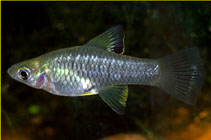
Etymology: Carlhubbsia: After Carl Leavitt Hubbs, 1894; he wrote more than 784 technical articles; museum of Zoology, curator of fishes, Michigan (1920-1944). Professor of Marine Biology in La Jolla, 1944.
Eponymy: Professor Carl Levitt (Leavitt) Hubbs (1894–1979) was a giant of American ichthyology. [...] Alfred Vincent Kidder (1885–1963) was an American archaeologist. [...] (Ref. 128868), visit book page.
More on author: Hubbs.
Ambiente: milieu / zona climatica / distribuzione batimetrica / gamma di distribuzione
Ecologia
; acqua dolce pelagico; pH range: 7.0 - 7.8; dH range: 20 - 2060; non migratori. Tropical; 24°C - 30°C (Ref. 26130)
Central America: Mexico to Guatemala.
Dimensione / Peso / Età
Maturità: Lm ? range ? - ? cm
Max length : 5.0 cm TL maschio/sesso non determinato; (Ref. 26130); 6.0 cm (female)
Inhabits flowing and standing waters.
Ciclo vitale e comportamento di accoppiamento
Maturità | Riproduzione | Deposizione | Uova | Fecondità | Larve
Gestation lasts for about 24 to 28 days. Female gives birth to 10 to 30 young. Reaches sexual maturity after its 4 months.
Lucinda, P.H.F., 2003. Poeciliidae (Livebearers). p. 555-581. In R.E. Reis, S.O. Kullander and C.J. Ferraris, Jr. (eds.) Checklist of the Freshwater Fishes of South and Central America. Porto Alegre: EDIPUCRS, Brazil. (Ref. 50894)
Stato della Lista Rossa IUCN (Ref. 130435: Version 2025-2 (Global))
Minaccia per l'uomo
Harmless
Usi umani
Strumenti
Rapporti speciali
Scarica XML
Fonti Internet
Stime basate su modelli
Indice di diversità filogenetica (Fonte Biblio.
82804): PD
50 = 0.7500 [Uniqueness, from 0.5 = low to 2.0 = high].
Bayesian length-weight: a=0.01047 (0.00458 - 0.02392), b=3.14 (2.96 - 3.32), in cm total length, based on LWR estimates for this (Sub)family-body shape (Ref.
93245).
Livello trofico (Fonte Biblio.
69278): 3.0 ±0.4 se; based on size and trophs of closest relatives
Resilienza (Fonte Biblio.
120179): Alto, tempo minimo di raddoppiamento della popolazione meno di 15 mesi (tm=0.3).
Vulnerabilità della pesca (Ref.
59153): Low vulnerability (10 of 100).
🛈