Klassifizierung / Names
Namen | Synonyme | Catalog of Fishes(Gattung, Arten) | ITIS | CoL | WoRMS | Cloffa
>
Cyprinodontiformes (Rivulines, killifishes and live bearers) >
Poeciliidae (Poeciliids) > Poeciliinae
Etymology: Brachyrhaphis: Greek, brachys, eia = short + Greek, raphis = needle (Ref. 45335).
More on author: Regan.
Umwelt: Milieu / Klimazone / Tiefenbereich / Verbreitungsgebiet
Ökologie
; süßwasser pelagisch; pH range: ? - 8.0; dH range: ? - 8.5; standorttreu. Tropical; 23°C - 32°C (Ref. 36880)
Central America: Costa Rica.
Größe / Gewicht / Alter
Geschlechtsreife: Lm ? range ? - ? cm
Max length : 6.0 cm SL Männchen/unbestimmt; (Ref. 36880)
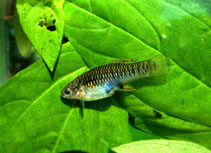
Sides with up to 12 dark bars, more prominent on males and diffused or absent in females. Caudal fin margin yellow or orange, submarginal darkened band in males. Distal half of dorsal fin yellowish or orange; the margin of the fin is black. Anal fin yellow with a black blotch. The gonopodium is shorter (mean 30.4% of SL) than B. olomina (mean 32.9 of SL) (Ref. 36880).
Body shape (shape guide): elongated; Cross section: oval.
An insectivorous fish which lives in waters of low to moderate current velocity, rarely in strong current, from 3-540 m elevation; in temperatures 23-32°C. Inhabits midwater or near the surface in brooks and creeks; sometimes in shallow waters of large rivers (Ref. 36880).
Lebenszyklus und Paarungsverhalten
Geschlechtsreife | Fortpflanzung | Ablaichen | Eier | Fruchtbarkeit | Larven
Every 28 days, female gives birth to 10-30 young.
Can be very aggressive, even to their own Young. This updates previous information from Ref. 26130.
Lucinda, P.H.F., 2003. Poeciliidae (Livebearers). p. 555-581. In R.E. Reis, S.O. Kullander and C.J. Ferraris, Jr. (eds.) Checklist of the Freshwater Fishes of South and Central America. Porto Alegre: EDIPUCRS, Brazil. (Ref. 50894)
IUCN Rote Liste Status (Ref. 130435: Version 2025-2 (Global))
Bedrohung für Menschen
Harmless
Nutzung durch Menschen
Tools
Zusatzinformationen
Download XML
Internet Quellen
Schätzungen auf der Grundlage von Modellen
Phylogenetischer Diversitätsindex (Ref.
82804): PD
50 = 0.5002 [Uniqueness, from 0.5 = low to 2.0 = high].
Bayesian length-weight: a=0.00851 (0.00369 - 0.01962), b=3.15 (2.96 - 3.34), in cm total length, based on LWR estimates for this (Sub)family-body shape (Ref.
93245).
Trophische Ebene (Ref.
69278): 3.2 ±0.40 se; based on food items.
Widerstandsfähigkeit (Ref.
120179): hoch, Verdopplung der Population dauert weniger als 15 Monate. (tm<1).
Anfälligkeit der Fischerei (Ref.
59153): Low vulnerability (10 of 100).
🛈