Lớp phụ Cá sụn (cá mập và cá đuối) (sharks and rays) >
Carcharhiniformes (Ground sharks) >
Triakidae (Houndsharks) > Galeorhininae
Etymology: Galeorhinus: galeo, probably based on G. galeus (see below); rhinus, an ancient name for sharks, from rhine (Gr.), rasp, alluding to their rasp-like skin (See ETYFish); galeus: From galeos, a small shark or dogfish per Aristotle (sometimes translated as weasel), possibly referring to the pointed snouts, swift movements and/or rapacious feeding behavior of smaller predatory sharks1 (See ETYFish).
More on author: Linnaeus.
Môi trường: môi trường / vùng khí hậu / Mức độ sâu / phạm vi phân phối
Sinh thái học
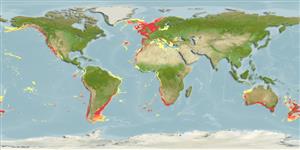
biển sống nổi và đáy; Ở đại duơng, biển (Ref. 51243); mức độ sâu 0 - 1100 m (Ref. 26346), usually 2 - 471 m (Ref. 43939). Subtropical; 70°N - 58°S, 111°E - 37°E
World-wide in cold to warm temperate waters.
Chiều dài lúc trưởng thành đầu tiên / Bộ gần gũi / Khối lượng (Trọng lượng) / Tuổi
Chín muồi sinh dục: Lm 144.1, range 120 - 185 cm
Max length : 193 cm TL con đực/không giới tính; (Ref. 40637); 195.0 cm TL (female); common length : 160 cm TL con đực/không giới tính; (Ref. 9258); Khối lượng cực đại được công bố: 44.7 kg (Ref. 40637); Tuổi cực đại được báo cáo: 55 các năm (Ref. 6871)
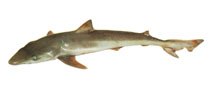
Các tia vây lưng cứng (tổng cộng) : 0; Tia cứng vây hậu môn: 0. A large houndshark with a long, pointed snout, a large mouth, and small blade-like teeth; 2nd dorsal about as large as anal fin and terminal caudal lobe as long as rest of fin (Ref. 5578). Greyish above, white below; young with black markings on fins (Ref. 5578).
Body shape (shape guide): elongated.
Mainly demersal on continental and insular shelves, but also on the upper slopes, at depths from near shore to 550 m (Ref. 6871), but has been shown to be pelagic in the open ocean (frequently caught on floating tuna longlines over deep water, and many New Zealand-tagged specimens have been recaptured in Australia) (Ref. 26346). Occurs in small schools that are highly migratory in higher latitudes in their range (Ref. 244). There is pronounced partial segregation by size and sex in some areas (Ref. 244). Feeds on fishes (bottom as well as pelagic species, Ref. 26346), crustaceans, cephalopods, worms, and echinoderms (Ref. 244). Ovoviviparous (Ref. 50449). Targeted for human consumption, liver for squalene oil, fins for soup (Ref. 244); also utilized as fishmeal (Ref. 13563). Marketed fresh, dried-salted, and frozen (Ref. 9987). Adapts well in captivity if carefully captured and handled (Ref. 12951).
Ovoviviparous, without a yolk-sac placenta (Ref. 244). Embryos feed solely on yolk (Ref. 50449). 6 to 52 young in a litter (Ref. 26346). Litter size increases with the size of the mother. Embryos reach 30-36 cm TL at birth (Ref. 6080). In the southern waters of Australia, newly born and older juveniles (30-70 cm long) aggregate in 'nursery areas' found in shallow waters.They move to deeper coastal waters to over-winter. The following spring finds most of these young returning to their nursery areas. The older ones, aged 2 years and over move instead to eastern Bass Strait where most of the immature stock are found. The length of an average full-term embryo is 32 cm. Spawning frequency is once every year, ovulation occurring in early summer and parturition is completed by January of the following year. Gestation period lasts for about 12 months (Ref. 6390, 6871).
Compagno, L.J.V., 1984. FAO Species Catalogue. Vol. 4. Sharks of the world. An annotated and illustrated catalogue of shark species known to date. Part 2 - Carcharhiniformes. FAO Fish. Synop. 125(4/2):251-655. Rome: FAO. (Ref. 244)
Tình trạng Sách đỏ IUCN (Ref. 130435: Version 2025-2 (Global))
Mối đe dọa đối với con người
Sử dụng của con người
Các nghề cá: tính thương mại cao; cá để chơi: đúng; Bể nuôi cá: Bể cá công cộng
Các công cụ
Báo cáo đặc biệt
Tải xuống XML
Các nguồn internet
Ước tính dựa trên mô hình
Nhiệt độ ưa thích (Tài liệu tham khảo
123201): 6.7 - 23.2, mean 12.3 °C (based on 7314 cells).
Chỉ số đa dạng phát sinh loài (Tài liệu tham khảo
82804): PD
50 = 1.0000 [Uniqueness, from 0.5 = low to 2.0 = high].
Bayesian length-weight: a=0.00479 (0.00363 - 0.00631), b=2.99 (2.91 - 3.07), in cm total length, based on LWR estimates for this species (Ref.
93245).
Mức dinh dưỡng (Tài liệu tham khảo
69278): 4.3 ±0.1 se; based on diet studies.
Generation time: 11.9 (6.9 - 14.7) years. Estimated as median ln(3)/K based on 12
growth studies.
Thích nghi nhanh (Tài liệu tham khảo
120179): thấp, thời gian nhân đôi của chủng quần tối thiểu là 4.5 - 14 năm (rm=0.033; tmax=55; Fec=6-52).
Prior r = 0.06, 95% CL = 0.04 - 0.09, Based on 2 full stock assessments.
Sự dễ bị tổn thương của nghề đánh cá (Ref.
59153): Very high vulnerability (76 of 100).
🛈
Sự dễ bị tổn thương của khí hậu (Ref.
125649): High vulnerability (62 of 100).
🛈
Chất dinh dưỡng (Ref.
124155): Calcium = 8.56 [1.46, 48.15] mg/100g; Iron = 0.465 [0.128, 1.502] mg/100g; Protein = 20 [18, 22] %; Omega3 = 0.18 [0.11, 0.30] g/100g; Selenium = 44.2 [13.5, 139.5] μg/100g; VitaminA = 13.1 [4.2, 44.7] μg/100g; Zinc = 0.409 [0.194, 0.769] mg/100g (wet weight); based on
nutrient studies.