>
Blenniiformes (Blennies) >
Tripterygiidae (Triplefin blennies) > Tripterygiinae
Etymology: malcolmi: The genus is named after J.R. Forster, naturalist on Cook's second voyage to New Zealand. malcolmi named after Malcolm Francis, collector of the holotype of this species.
Eponymy: Dr Malcolm Philip Francis (d: 1954) is a New Zealand fisheries scientist and marine ecologist who has spent over thirty-nine years studying the population biology of coastal and pelagic fishes. [...] (Ref. 128868), visit book page.
Lingkungan: lingkungan / zona iklim / kisaran kedalaman / jangkauan distribusi
Ekologi
laut dasar (demersal); kisaran kedalaman 2 - 35 m (Ref. 13227), usually 10 - 25 m (Ref. 9003). Temperate
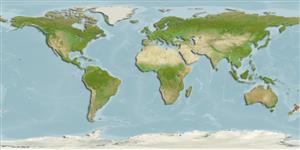
Southwest Pacific: endemic to New Zealand.
Ukuran / Berat / umur
Kematangan: Lm ? range ? - ? cm
Max length : 12.2 cm SL jantan/; (Ref. 13227)
deskripsi pendek
Kunci identifiaksi (pengenalan) | Morfologi | Morfometrik
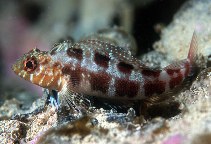
Duri punggung (Keseluruhan (total)) : 27 - 32; duri punggung lunak (Keseluruhan (total)) : 12 - 16; Duri dubur: 2; Sirip dubur lunak: 26 - 30; vertebrata, bertulang belakang: 43 - 47. Body elongated, laterally compressed posteriorly; mouth strongly angled upward; notched scales absent; short, distally complex gill rakers, body yellow with a broad, black stripe
extending along upper side of body. Dorsal fin formula V-0N-0-1-0-1. Six procurrent rays in upper lobe, 10 in lower lobe; in upper caudal lobe, one procurrent ray between upper lobe and posterior epural, 4 rays opposite epurals, 1 anterior first epural; in lower lobe, 1 procurrent ray between lower lobe and haemal spine of second preural vertebra, 4 opposite haemal spine of second preural vertebra, 5 anterior to haemal spine of second preural vertebra (Ref. 84085). Head and gill cover olive brown with pale stripes, body with 6 broad reddish vertical bands with irregular white bands between. Anterior bands extending to the dorsal fin (Ref. 9003).
Body shape (shape guide): fusiform / normal.
Facultative air-breathing in the genus (Ref. 126274); Adults are abundant on rocky reefs from 10 to 25m, recorded from 2 to 33m (Ref. 84085). They occur in low tide pools and subtidal areas and prefer overhangs and holes containing sponges and bryozoans (Ref. 9003). Juveniles are found in shallow waters, while adults are more abundant in deeper waters. They feed mainly on crustaceans and small gastropods (Ref. 13227). Eggs are hemispherical and covered with numerous sticky threads that anchor them in the algae on the nesting sites (Ref. 240). Larvae are planktonic which occur primarily in shallow, nearshore waters (Ref. 94114).
Fricke, R., 1994. Tripterygiid fishes of Australia, New Zealand and the southwest Pacific Ocean (Teleostei). Theses Zool. 24:1-585. (Ref. 13227)
Status IUCN Red List (Ref. 130435: Version 2025-2 (Global))
ancaman kepada manusia
Harmless
penggunaan manusia
Alat, peralatan
laporan khas
muat turun XML
Sumber internet
Estimasi berdasarkan model
Suhu yang disukai (Acuan
123201): 15.5 - 18.1, mean 16.6 °C (based on 10 cells).
Indeks keanekaragaman filogenetik (Acuan
82804): PD
50 = 0.5039 [Uniqueness, from 0.5 = low to 2.0 = high].
Bayesian length-weight: a=0.00646 (0.00330 - 0.01265), b=3.09 (2.91 - 3.27), in cm total length, based on LWR estimates for this species & (Sub)family-body (Ref.
93245).
Tingkat Trofik (Acuan
69278): 3.4 ±0.54 se; based on food items.
Daya lenting (Acuan
120179): Tinggi, Waktu penggandaan populasi minimum kurang dari 15 bulan (Preliminary K or Fecundity.).
Kerentanan Penangkapan Ikan (Ref.
59153): Low vulnerability (10 of 100).
🛈
Nutrisi (Ref.
124155): Calcium = 112 [68, 258] mg/100g; Iron = 0.621 [0.373, 1.104] mg/100g; Protein = 18.5 [17.5, 19.5] %; Omega3 = 0.686 [0.368, 1.327] g/100g; Selenium = 9.97 [4.73, 21.02] μg/100g; VitaminA = 15.9 [4.3, 57.7] μg/100g; Zinc = 0.911 [0.619, 1.332] mg/100g (wet weight);