>
Blenniiformes (Blennies) >
Blenniidae (Combtooth blennies) > Salariinae
Etymology: Parablennius: Greek, para = the side of + Greek, blennios = mucus (Ref. 45335).
Eponymy: Jean Louis Florent Polydore Roux (1792–1833) was a French artist and naturalist. [...] (Ref. 128868), visit book page.
Ambiente: milieu / zona climatica / distribuzione batimetrica / gamma di distribuzione
Ecologia
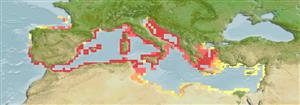
marino demersale; distribuzione batimetrica 0 - 42 m (Ref. 5981). Subtropical; 46°N - 30°N, 11°W - 36°E
Northeast Atlantic: off Portugal. Also known from the northern Mediterranean.
Dimensione / Peso / Età
Maturità: Lm ? range ? - ? cm
Max length : 8.0 cm TL maschio/sesso non determinato; (Ref. 5981)
Facultative air-breathing in the genus (Ref. 126274); Adults occur in the shallow littoral zone to the zone beyond the influence of water movements, over light rocks or pebbles without algal cover and on secondary hard bottoms of coralligenous origin. They feed on periphyton, harpacticoids and algae. Males inhabit narrow piddock holes; they court by nodding, jumping out of hole and back again and swimming in a vertical position. Rivals are threatened by yawning, lateral display and circling, and are attacked by ramming and biting. Reproduction takes place from May to July. Attracted females spawn in resident hole of a males which guards eggs from several families (Ref. 5981). Oviparous. Eggs are demersal and adhesive (Ref. 205), and are attached to the substrate via a filamentous, adhesive pad or pedestal (Ref. 94114). Larvae are planktonic, often found in shallow, coastal waters (Ref. 94114).
Ciclo vitale e comportamento di accoppiamento
Maturità | Riproduzione | Deposizione | Uova | Fecondità | Larve
Oviparous, distinct pairing (Ref. 205).
Zander, C.D., 1986. Blenniidae. p. 1096-1112. In P.J.P. Whitehead, M.-L. Bauchot, J.-C. Hureau, J. Nielsen and E. Tortonese (eds.) Fishes of the North-eastern Atlantic and the Mediterranean, volume 3. UNESCO, Paris. (Ref. 5981)
Stato della Lista Rossa IUCN (Ref. 130435: Version 2025-2 (Global))
Minaccia per l'uomo
Harmless
Usi umani
Strumenti
Rapporti speciali
Scarica XML
Fonti Internet
Stime basate su modelli
Temperatura preferita (Fonte Biblio.
123201): 16.5 - 19.5, mean 18.1 °C (based on 54 cells).
Indice di diversità filogenetica (Fonte Biblio.
82804): PD
50 = 0.5000 [Uniqueness, from 0.5 = low to 2.0 = high].
Bayesian length-weight: a=0.00776 (0.00354 - 0.01702), b=3.00 (2.81 - 3.19), in cm total length, based on LWR estimates for this (Sub)family-body shape (Ref.
93245).
Livello trofico (Fonte Biblio.
69278): 3.0 ±0.0 se; based on diet studies.
Resilienza (Fonte Biblio.
120179): Alto, tempo minimo di raddoppiamento della popolazione meno di 15 mesi (Preliminary K or Fecundity.).
Vulnerabilità della pesca (Ref.
59153): Low vulnerability (10 of 100).
🛈
Nutrienti (Ref.
124155): Calcium = 295 [156, 644] mg/100g; Iron = 1.6 [1.0, 3.0] mg/100g; Protein = 18.1 [17.1, 19.1] %; Omega3 = 0.263 [0.141, 0.481] g/100g; Selenium = 20 [9, 43] μg/100g; VitaminA = 22.1 [6.4, 74.0] μg/100g; Zinc = 1.51 [0.99, 2.22] mg/100g (wet weight);