Environnement : milieu / zone climatique / profondeur / gamme de distribution
Écologie
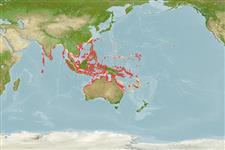
marin récifal; profondeur 0 - 25 m (Ref. 90102), usually 0 - 20 m (Ref. 27115). Tropical; 25°C - 29°C (Ref. 27115); 27°N - 30°S, 71°E - 171°E
Indo-West Pacific: Maldives, Laccadive Archipelago, India, Sri Lanka, Ogasawara Islands (Japan), eastern Indonesia, New Guinea, Australia, Solomon Islands, Vanuatu, New Caledonia and Philippines; Palau and Yap in Micronesia. Records from Viet Nam (Ref. 2682) is probably Siganus guttatus.
Taille / Poids / Âge
Maturité: Lm ? range ? - ? cm
Max length : 43.0 cm TL mâle / non sexé; (Ref. 9710); common length : 25.0 cm TL mâle / non sexé; (Ref. 9813)
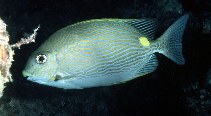
Épines dorsales (Total) : 13; Rayons mous dorsaux (Total) : 10; Épines anales: 7; Rayons mous anaux: 9; Vertèbres: 13. This species is distinguished by the following characters: body deep and compressed; greatest body depth 1.9-2.2 in SL; longest dorsal-fin spines 4th to 8th, a little longer (1.1-1.3 times) the last dorsal-fin spine. Colour blue dorsally, silvery below; horizontal golden bronze bands, some broken, running along single sides of trunk, breaking up into spots near bases of dorsal and anal fins and on caudal peduncle, and (except in specimens from South India), spots also on nape; iris silvery and unspotted. Similar with Siganus guttatus in having a diagonal line across cheek from below orbit to corner of mouth, a bright yellow spot about size of orbit on sides at base of last few rays of dorsal fin, and a bluish caudal fin with rows of golden spots which appear as 3 or 4 cross bars on the folded fin. Differs with Siganus guttatus mainly by having mainly lines instead of spots (Ref. 9813, 90102).
Body shape (shape guide): fusiform / normal; Cross section: compressed.
Adults inhabit shallow areas, typically 5 m; juveniles common around estuarine areas including mangrove areas and seagrass flats; adults in protected waters such as lagoons and bays in the vicinity of rocky substrata or reefs (resting on rubble or sandy bottoms). Form schools that diminish with age, down to 10-25 fish by adult stage, although congregations may consist of several thousand fish during spawning period. Feed by scraping encrusting algae from beach rock or pavement areas of coral reefs or by browsing on larger coarse algae. Caught mainly with set nets and fixed traps; common in markets where it is sold fresh (Ref. 9813).
Cycle de vie et comportement reproducteur
Maturité | Reproduction | Frai | Œufs | Fécondité | Larves
Smallest female to spawn was 23 cm, the largest 33 cm SL. Spawning apparently occurs not until the fish is 2 years old.
Woodland, D.J., 1990. Revision of the fish family Siganidae with descriptions of two new species and comments on distribution and biology. Indo-Pac. Fish. (19):136 p. (Ref. 1419)
Statut dans la liste rouge de l'IUCN (Ref. 130435: Version 2025-2 (Global))
Utilisations par l'homme
Pêcheries: commercial; Aquarium: Commercial
Outils
Articles particuliers
Télécharger en XML
Sources Internet
Estimations basées sur des modèles
Température préférée (Réf.
123201): 24.9 - 29, mean 28 °C (based on 726 cells).
Indice de diversité phylogénétique (Réf.
82804): PD
50 = 0.5000 [Uniqueness, from 0.5 = low to 2.0 = high].
Bayesian length-weight: a=0.01698 (0.01057 - 0.02728), b=3.01 (2.88 - 3.14), in cm total length, based on LWR estimates for this species & Genus-body shape (Ref.
93245).
Niveau trophique (Réf.
69278): 2.0 ±0.00 se; based on food items.
Generation time: 1.8 ( na - na) years. Estimated as median ln(3)/K based on 1
growth studies.
Résilience (Réf.
120179): Haut, temps minimum de doublement de population inférieur à 15 mois (K=0.6; tm=2).
Vulnérabilité de la pêche (Ref.
59153): Low to moderate vulnerability (25 of 100).
🛈
Nutriments (Ref.
124155): Calcium = 33.6 [17.4, 79.3] mg/100g; Iron = 0.665 [0.322, 1.397] mg/100g; Protein = 19 [18, 20] %; Omega3 = 0.122 [0.070, 0.220] g/100g; Selenium = 21.1 [9.3, 46.7] μg/100g; VitaminA = 42 [13, 141] μg/100g; Zinc = 1.51 [0.60, 2.86] mg/100g (wet weight);