>
Acanthuriformes (Surgeonfishes) >
Siganidae (Rabbitfishes)
Etymology: Siganus: Latin, siganus = a fish, rabbit fish; by the similarity of the nose (Ref. 45335).
More on author: Forsskål.
Umwelt: Milieu / Klimazone / Tiefenbereich / Verbreitungsgebiet
Ökologie
seewasser riff-verbunden; tiefenbereich 1 - ? m (Ref. 9710), usually 5 - 30 m (Ref. 27115). Tropical; 24°C - 28°C (Ref. 27115); 30°N - 35°S
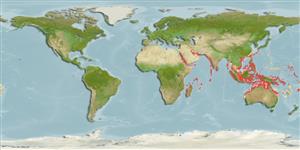
Indian Ocean: Red Sea and East Africa to the Andaman Sea.
Größe / Gewicht / Alter
Geschlechtsreife: Lm ? range ? - ? cm
Max length : 40.0 cm TL Männchen/unbestimmt; (Ref. 4407); common length : 35.0 cm TL Männchen/unbestimmt; (Ref. 9813)
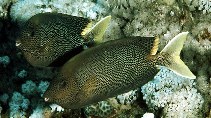
Rückenflossenstacheln (insgesamt) : 13; Rückenflossenweichstrahlen (insgesamt) : 10; Afterflossenstacheln: 7; Afterflossenweichstrahlen: 9; Wirbelzahl: 13. Indian Ocean subspecies. S. s. laqueus greyish green with head and body covered with chocolate brown spots; in S. s. stellatus, background color is yellowish. Trailing edges of soft parts of dorsal and anal fins, perimeter of caudal fin and a saddle over the caudal peduncle are markedly paler than the rest. Silvery iris, tinted brown or green, with 10 equally spaced spots. Spines stout; pungent only in juveniles. Preopercular angle 92°-103°. Strong scales cover the cheeks. Usually midline of thorax fully scaled, but pelvic ridges sometimes without scales.
Body shape (shape guide): short and / or deep; Cross section: compressed.
Common in coral reefs; juveniles enter weedy estuaries (Ref. 4407). Juveniles and subadults form schools, adults in pairs. Adults feed on benthic seaweeds (Ref. 9813). Anterolateral glandular grooves with venom gland (Ref. 57406).
Lebenszyklus und Paarungsverhalten
Geschlechtsreife | Fortpflanzung | Ablaichen | Eier | Fruchtbarkeit | Larven
Woodland, D.J., 1990. Revision of the fish family Siganidae with descriptions of two new species and comments on distribution and biology. Indo-Pac. Fish. (19):136 p. (Ref. 1419)
IUCN Rote Liste Status (Ref. 130435: Version 2025-2 (Global))
Nutzung durch Menschen
Fischereien: kommerziell; Aquarium: Kommerziell
Tools
Zusatzinformationen
Download XML
Internet Quellen
Schätzungen auf der Grundlage von Modellen
Bevorzugte Temperatur (Ref.
123201): 25.3 - 29.1, mean 28.1 °C (based on 1240 cells).
Phylogenetischer Diversitätsindex (Ref.
82804): PD
50 = 0.5000 [Uniqueness, from 0.5 = low to 2.0 = high].
Bayesian length-weight: a=0.01514 (0.00830 - 0.02759), b=2.97 (2.81 - 3.13), in cm total length, based on LWR estimates for this species & Genus-body shape (Ref.
93245).
Trophische Ebene (Ref.
69278): 2.7 ±0.30 se; based on food items.
Widerstandsfähigkeit (Ref.
120179): hoch, Verdopplung der Population dauert weniger als 15 Monate. (Preliminary K or Fecundity.).
Anfälligkeit der Fischerei (Ref.
59153): Low to moderate vulnerability (30 of 100).
🛈
Nährstoffe (Ref.
124155): Calcium = 32.4 [14.9, 72.5] mg/100g; Iron = 0.608 [0.294, 1.419] mg/100g; Protein = 18.8 [17.3, 20.3] %; Omega3 = 0.107 [0.055, 0.211] g/100g; Selenium = 21.5 [8.8, 53.9] μg/100g; VitaminA = 32.4 [9.2, 113.5] μg/100g; Zinc = 1.09 [0.43, 2.31] mg/100g (wet weight);