>
Acanthuriformes (Surgeonfishes) >
Siganidae (Rabbitfishes)
Etymology: Siganus: Latin, siganus = a fish, rabbit fish; by the similarity of the nose (Ref. 45335).
More on author: Linnaeus.
Ambiente: milieu / zona climatica / distribuzione batimetrica / gamma di distribuzione
Ecologia
marino; salmastro associati a barriera corallina; oceanodromo (Ref. 51243); distribuzione batimetrica 0 - 20 m (Ref. 90102), usually 2 - 20 m (Ref. 27115). Tropical; 25°C - 28°C (Ref. 27115); 30°N - 20°S
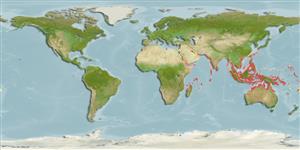
Indo-Pacific: Persian Gulf, Gulf of Oman, Pakistan, India, Sri Lanka, Burma, Andaman Islands, Thailand, Viet Nam, southern China, Malaysia, Indonesia, Philippines, Australia, New Guinea, Vanuatu and New Caledonia. Records for the Ryukyu and Ogasawara Islands could be based on strays (Ref. 9813).
Dimensione / Peso / Età
Maturità: Lm ? range ? - ? cm
Max length : 53.0 cm TL maschio/sesso non determinato; (Ref. 9710); common length : 30.0 cm TL maschio/sesso non determinato; (Ref. 9813)
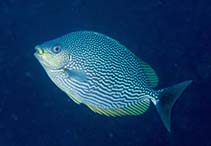
Spine dorsali (totale) : 13; Raggi dorsali molli (totale) : 10; Spine anali: 7; Raggi anali molli: 9; Vertebre: 13. Body bronze above, white on belly and thorax; iris light brown; pectoral fins hyaline, pelvic fins white. Slender and pungent dorsal spines; anal spines stout. Preopercular angle 78°-92°. Strong scales cover cheeks. Midline of thorax scaled but not pelvic ridges. Broad-based triangular flap of anterior nostril reaching half way to posterior nostril in juveniles, reducing to a small crescent with age.
Body shape (shape guide): short and / or deep; Cross section: compressed.
Occurs in small schools of up to 10 individuals or so, in shallow coastal waters, brackish lagoons and rocky or coral reefs. Feeds on algae attached to the substrate and on floating algal fragments. Found resting in midwater at depths of 2 to 6 m when not feeding. Marketed fresh (Ref. 9813, 48637). Maximum depth from Ref. 027115.
Ciclo vitale e comportamento di accoppiamento
Maturità | Riproduzione | Deposizione | Uova | Fecondità | Larve
Woodland, D.J., 1990. Revision of the fish family Siganidae with descriptions of two new species and comments on distribution and biology. Indo-Pac. Fish. (19):136 p. (Ref. 1419)
Stato della Lista Rossa IUCN (Ref. 130435: Version 2025-2 (Global))
Usi umani
Pesca: commerciale; Acquario: Commerciale
Strumenti
Rapporti speciali
Scarica XML
Fonti Internet
Stime basate su modelli
Temperatura preferita (Fonte Biblio.
123201): 25.5 - 29.1, mean 28.3 °C (based on 1152 cells).
Indice di diversità filogenetica (Fonte Biblio.
82804): PD
50 = 0.5000 [Uniqueness, from 0.5 = low to 2.0 = high].
Bayesian length-weight: a=0.01479 (0.00925 - 0.02365), b=3.05 (2.92 - 3.18), in cm total length, based on LWR estimates for this species & Genus-body shape (Ref.
93245).
Livello trofico (Fonte Biblio.
69278): 2.4 ±0.08 se; based on food items.
Resilienza (Fonte Biblio.
120179): Medio, tempo minimo di raddoppiamento della popolazione 1.4 - 4.4 anni (Preliminary K or Fecundity.).
Vulnerabilità della pesca (Ref.
59153): Moderate vulnerability (41 of 100).
🛈
Nutrienti (Ref.
124155): Calcium = 26.6 [12.9, 59.8] mg/100g; Iron = 0.564 [0.265, 1.268] mg/100g; Protein = 19 [18, 20] %; Omega3 = 0.102 [0.053, 0.199] g/100g; Selenium = 20 [8, 50] μg/100g; VitaminA = 27.5 [7.2, 104.7] μg/100g; Zinc = 1.26 [0.50, 2.78] mg/100g (wet weight);