Ambiente: milieu / zona climatica / distribuzione batimetrica / gamma di distribuzione
Ecologia
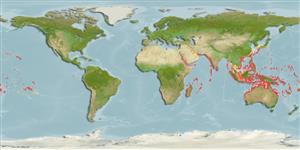
marino associati a barriera corallina; distribuzione batimetrica 0 - 40 m (Ref. 9813), usually 1 - 30 m (Ref. 27115). Tropical; 25°C - 29°C (Ref. 27115); 30°N - 30°S, 32°E - 128°W
Indo-Pacific: Red Sea and East Africa to Pitcairn. Often the only siganid present on remote islands like Pitcairn, Rapa and Line.
Lunghezza alla prima maturità / Dimensione / Peso / Età
Maturità: Lm ?, range 20 - ? cm
Max length : 40.0 cm TL maschio/sesso non determinato; (Ref. 9813); common length : 25.0 cm TL maschio/sesso non determinato; (Ref. 9813)
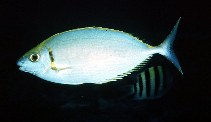
Spine dorsali (totale) : 13; Raggi dorsali molli (totale) : 10; Spine anali: 7; Raggi anali molli: 9; Vertebre: 13. This species is distinguished by the following characters: juveniles and adults with body oval and compressed, slender, fusiform, greatest body depth 2.4-3 in SL; anterior nostril with a long flap reaching to or past posterior nostril; last dorsal-fin spine very short, 2.6-3.5 times in longest dorsal-fin spine; last anal-fin spine shortest, 2.1-3.1 times in longest (second or third) anal-fin spine; caudal fin deeply forked. Colour of body blue or greyish above, silvery below; variations in markings (spots, curved lines); head and trunk usually covered with small yellow spots, bars, and commas, much larger than interspaces and quarter to 1/2 size of pupil; spots usually joining to form horizontal wavy lines, particularly on lower sides; yellow pectoral-fin axil, usually yellow stripes along base of dorsal fin and a dark brown bar immediately posterior to the upper opercular margin; colours fade rapidly at death so that head and trunk may be solid brown (Ref. 9813, 90102).
Body shape (shape guide): fusiform / normal; Cross section: compressed.
Inhabits coastal and inner reef slopes and lagoons. Usually occurs in large schools that swim fast and well above the substrate, occasionally all diving down to the bottom to feed (Ref. 48637). Juveniles and adults occur in small schools (2-100) around coral reefs, typically in surge zone at reef edge. Juveniles live near the surface in dense aggregations up to several km offshore, migrating to reef flats just prior to metamorphosis. Feeds on algae (Ref. 30573). Juveniles and adults not frequently found in markets; but prejuveniles form a brief but important fishery when migrating on to the reef flat, e.g. combined catch (with Siganus spinus of 16 tonnes in one season in Guam. Prejuveniles eaten fresh, pickled in brine or made into fish paste (Ref. 9813). Consumed as food although it is known to be occasionally poisonous (Ref. 4537). Used in Chinese medicine (Ref. 12166).
Ciclo vitale e comportamento di accoppiamento
Maturità | Riproduzione | Deposizione | Uova | Fecondità | Larve
Spawn in group (Ref. 240).
Woodland, D.J., 1990. Revision of the fish family Siganidae with descriptions of two new species and comments on distribution and biology. Indo-Pac. Fish. (19):136 p. (Ref. 1419)
Stato della Lista Rossa IUCN (Ref. 130435: Version 2025-2 (Global))
Usi umani
Pesca: commerciale; Acquario: Commerciale
Strumenti
Rapporti speciali
Scarica XML
Fonti Internet
Stime basate su modelli
Temperatura preferita (Fonte Biblio.
123201): 24.6 - 29, mean 27.8 °C (based on 1374 cells).
Indice di diversità filogenetica (Fonte Biblio.
82804): PD
50 = 0.5000 [Uniqueness, from 0.5 = low to 2.0 = high].
Bayesian length-weight: a=0.01349 (0.01090 - 0.01670), b=3.00 (2.95 - 3.05), in cm total length, based on LWR estimates for this species (Ref.
93245).
Livello trofico (Fonte Biblio.
69278): 2.0 ±0.0 se; based on diet studies.
Resilienza (Fonte Biblio.
120179): Alto, tempo minimo di raddoppiamento della popolazione meno di 15 mesi (K=0.75; tm=1).
Vulnerabilità della pesca (Ref.
59153): Low vulnerability (22 of 100).
🛈
Nutrienti (Ref.
124155): Calcium = 36.5 [18.7, 87.0] mg/100g; Iron = 0.714 [0.345, 1.487] mg/100g; Protein = 19 [18, 20] %; Omega3 = 0.132 [0.075, 0.234] g/100g; Selenium = 24.1 [10.7, 52.0] μg/100g; VitaminA = 37.9 [11.4, 131.2] μg/100g; Zinc = 1.51 [0.60, 2.86] mg/100g (wet weight); based on
nutrient studies.